Christian Counseling & Educational Foundation
1803 East Willow Grove Avenue
Glenside, PA 19038

Darby StricklandDavid Gunner GundersenLauren WhitmanTodd Stryd
October 12, 2026
When work feels repetitive, fruitless, or disconnected from our gifts, it’s easy to wonder whether it really matters. In this episode, Gunner Gundersen talks with CCEF colleagues Lauren Whitman, Darby Strickland, and Todd Stryd about why even good work can feel meaningless. They explore how the brokenness of work, cultural expectations, and the temptation to find our identity in our jobs can shape our experience of our daily responsibilities.
Scripture offers a different perspective: Work is a good gift from God, an opportunity to love our neighbors, and a place to serve the Lord—even when our efforts go unnoticed or produce little visible fruit. The conversation considers how to discern whether it’s time for a job change, how to seek wise counsel and grow in self-understanding, and how to encourage loved ones who are struggling at work. Through the mundane and the difficult, God sees our labor, and in Christ, our work is not in vain.
Mentioned in this episode: We hope you'll join us for the January 2027 term. Registration is open through November 17, but register by November 3 for the early registration discount. You can learn more and register at ccef.org/school.
00:00 Introduction and Helping Relationships Course
03:39 When Good Work Feels Meaningless
08:24 Why Work Can Feel Fruitless
12:35 Cultural Expectations and Finding Identity in Work
17:32 Work as a Good Gift from God
18:27 Vocation as a Way to Love Your Neighbor
20:44 God Sees Our Unseen and Unrewarded Labor
24:14 Should You Consider a Different Job?
28:23 Self-Understanding, Growth, and Wise Counsel
30:06 Encouraging Someone Who Struggles at Work
34:04 Our Labor Is Not in Vain
Hello, everyone! Welcome back to our CCEF podcast, “Where Life and Scripture Meet.” My name is Gunner Gundersen and I get to serve as the dean of faculty here at CCEF. If you want to learn how to walk alongside others with Christlike care, you can learn more through our online course that's coming up, Helping Relationships, with lectures by Ed Welch.
In this class, you can expect to grow and your ability to listen well, know people deeply, apply Scripture to their lives with care and wisdom, and offer biblical truth that will motivate others in their growth in Christ. We hope you'll join us for the January 2027 term. Registration is open through November the 17th, but you can register by November the 3rd for the early registration discount. You can learn more about this course and register at ccef.org/school.
I'm very happy today to be welcoming to the podcast three of my colleagues here at CCEF. We'll start with Lauren Whitman. Hey, Lauren.
Hey, Gunner. Thanks for being here with us.
Absolutely. And, Darby Strickland.
Hello.
Hey, Darby. And then Todd Stryd. Hey, Todd.
Hey, Gunner.
Well, before we get into our topic, let's kick this off with an important question that the people want to know. And that is, “What is your favorite thing about fall? What is your favorite thing about fall?” We're right around mid-fall, so I want to ask now, Todd, I just want to clarify, we're not asking your favorite thing about “The Fall.”
I know we have very biblical, literary, biblically literate listeners. Our favorite thing about “The Fall” is Genesis 3:15. Of course, the promise of )ne who would crush the serpent's head. But we're actually talking about what is your favorite thing about just fall as a season? Is that clear, Todd?
That is what I was going to choose. Might be closely related. So I love candy corn. And, even though it kind of tastes like wax, there's a lot of nostalgia to it. And it's maybe a product of the fall, but I love it.
I love it. Have you loved candy corn since you were, like, young?
Yeah, that's that's, that's where it comes from. Just an association with Halloween, the fall, being a kid.
Alright. Who else? What's your favorite thing about fall?
Well, I grew up in Florida. This is my 19th fall up here in the northeast. And yeah, having grown up in Florida and just not having seasons, you know, down there, I am still just so appreciative of the change in the weather. And of course, the changing leaf colors is just brilliant. And I love to watch the progression.
I would probably join you in that. Lauren I think my favorite thing is the colors, just how vibrant they are and just kind of the sense of promise that it's coming. I did spend seven years in Houston, as you know, and so we really didn't have nearly as much of a fall. And so being somewhere where we have those, the colors on the trees change is really beautiful.
It's quite glorious. I think also to like the coolness at night, the way the coolness comes in, and then the crunching under the feet. I think there's like it's just the beauty visually, but also it's crisp. There's just a crispness about it that I really like the sensory experience of fall, I would say overall.
Absolutely. And I wish you all could see us now because we were commenting before we hit record that we are dressed in a very fall-like family photo kind of way right now. So we are we're dressed for it as well.
Coincidentally, we did not plan this.
We didn't. Yeah, we just showed up. There's no color coding on the wardrobe requirement for our podcast here. Well, thank you so much for joining me for the conversation. I am very excited to talk about what is a very relevant topic. And that topic is when work feels meaningless. And before we dive into this and share a little bit, maybe about our own personal experiences in this arena, I just want to clarify, we are talking here about ethical work. Work that is done to God's glory, not talking about unethical things that really we should find a way to move on from and get out of and avoid. But we want to talk a little bit about how we should think about our work when we know it's good work, yet it feels meaningless. Just to kick us off, can you think of a season when maybe your own work or vocation felt meaningless to you?
Yeah, when you posed that question, Gunner, I think about housework. There's just a season when the kids were little and it was just ongoing, never ending. You clean something, and it was never tidy. It just felt really mundane. Just, “Do I have any meaning?” Like, came questions from that. But just even in particular I remember the homeschooling season, I just hated making my kids lunch.
Like, every day I have to feed these kids three times a day. And when the question came, “What’s for lunch?” I just, you know, it was what I was supposed to be doing and just not having an answer for that that was easy or enjoyable or wasn't a fuss or someone wouldn't fuss about. Right? So even though I knew what I was doing was vital to their survival, it just became tedious to me, it just really became a drudgery.
After college, I was a substitute teacher and then a teacher for several years. And of course, teaching in itself is very meaningful. And I didn't question that. But I think my personal experience of, “Is this a fit for me and how I want to spend my time?” and how my gifts and skills are able to be used.
I think there was yeah, there was some dissonance there. And that was the struggle of, “I know the work is meaningful, but it doesn't feel like a good fit and having to wrestle through that.”
You know, for me, I think this meets some of the criteria and t's a portion of a job I had in high school. I worked for a fast food fried chicken restaurant, and it seems like part of my job description was I was the designated deep fryer cleaner, and so I would have to empty out this 350 degree oil and then stick my head in there and clean it.
And it was usually getting burned and inhaling chemicals. And I think where it maps on to this question is it was just a very despairing end to my night. Every single night I, I, I knew what was coming and it felt like it was just going to happen again the very next time I worked.
Sounds like you needed a bowl of candy corn there, Todd, to keep you company.
That might have helped.
I think what we're sharing are great illustrations of, as we've said, work or vocations, roles, seasons that we know are meaningful. We're doing something that does serve others. It's helpful. Or it's a beautiful calling from the Lord, even in some of these cases that everybody would recognize as that. And yet we can have that feeling. For me, I remember graduating college and going back home to Oklahoma and having spent four years studying and preparing and thinking about what would be next, and I came back to do a data entry job for a small ministry that was led by one of my in-laws.
It was only going to be a 12-week job, and it was literally staring at a spreadsheet and entering addresses into it. And I remember being so excited when they asked me one day if I would go out and clean the shed, because I just got to go outside and I got to do something else. It was so hot out there and humid, but I was thrilled to be doing anything else.
And I remember really wrestling with this sense of this is temporary. It seems so mundane, and I did not expect to be doing this. And that maybe segues a little bit into just what are some reasons why work can feel meaningless? We've maybe touched on this and some of the things we've shared already from personal experience, but what are some of those reasons why I can feel this way?
Gunner, I feel like, in a macro sense, what strikes me first is that, like all facets of these things are broken. So work itself as it's meant to exist is broken. Then we are broken. How we perceive it, how we fit it into our world. And then the systems around us that, that give us jobs, they are typically broken.
So it's just it's broken all around, which just it means it's, it's overwhelming and it's hard to even know where to start to think about addressing or changing that.
Yeah, just, right. The Christmas carol, “as far as the curse is found,” right, the curse directly impacts our ability to work. And I think we often think that our efforts should equal outcome. But one of the greatest things of the curse is that it's so futile, right? The ground just resists Adam's labor. The thorns keep coming back.
You know, just thinking about, even in my house, keeping the analogy, like the toilet gets dirty. The next day, there's a new pile of laundry. And our efforts don't reap what we had hoped for just because of the curse. And it's, just to Todd's point, it's in every facet of our work, who we are, and where we're serving.
I think even thinking again about my personal experience with teaching, there was a sense that I didn't really choose this. It was more like, “I know I have to get a job. I have, you know, a degree that opens up only certain options.” And so just feeling like I didn't really choose this in the manner that you would hope to be able to kind of choose and forge a path for yourself.
So I think that can be difficult where I'm doing this, but this isn't really something that I saw for myself or even would have chosen for myself. I think that, again, with my personal experience, it's just that sense of like, “I'm doing something. I'm spending time doing something that doesn't seem to best align with how I see, or perceive, my skills and gifts and how I want to use those skills and gifts.”
If there's a real true sense that, you know, there aren't really avenues in this particular job to express the skills and gifts that I would like to, I think that can also contribute to a sense of meaninglessness in our work.
I found sometimes that a shift in role can lead to that. When the previous role had a lot of relationships and built experiences and there were memories involved in that, and then you, you make a shift and all of that goes away. And suddenly I'm a rookie again, and I don't have the relationships and I don't necessarily have the trust.
And there's so much that I have to learn and get used to. And it may not be that the work feels meaningless per se, but in comparison with the people that maybe really established and seem very effective and trusted and for good reason. I'm the newcomer, and I've had that experience several different times in life and have realized that sometimes those early seasons can also, the early in the season of a new role can tempt me to to feel like, when is this going to be meaningful? When am I going to be able to make a contribution? Or when will these relationships be in a place where maybe they feel the way that you want those kinds of work relationships to be? What are some, some burdens that we often carry that may be the result of our work feeling meaningless to us? What are some of those weights that we can end up carrying as we go through this process or through these seasons?
I think the…one of the burdens that comes to mind is just how, as finite creatures, we are just, we’re susceptible to the messages that we're receiving. We're dependent on what we are told, how the world works. What a job is supposed to mean, and how it's supposed to fit, and how we're supposed to think about it, and we're so inundated, by different messages, whether it's from our culture, from our parents, our family, our friends, that, if that message is an incorrect one or an unhelpful one, we don't have a lot of choice of, you know, “I only want access to the real message. I just want an accurate, true message.” We're susceptible to whatever is coming at us. And oftentimes that is not a helpful message about how these things fit.
Yeah, I think, Todd, you're on to something, which is it's important to be aware of what messages we've heard and been influenced by, and how those messages then lend themselves to the expectations we have formed about what work should be or what work should feel like. I think growing an awareness of our own expectations can be really helpful in sorting through an experience like, yeah, when your work is feeling meaningless.
So I think that's important. And, you know, even for us, you know, to reflect, you know, on our culture in particular, you know, I think we could spend a lot of time thinking about what are some of those messages and what are some of those expectations that the culture says, “You probably should have this experience at work, which, you know, we want to, it puts a lot the culture puts a lot of weight and freight onto what work should be, what it should feel like it should be, you know, a good fit, you know, with who you are.
It should reflect who you are in a meaningful way. And it should, you know, carry a lot of purpose to your overall sense of life. So just being aware again of, of what are some of those messages that I've received and to what degree am I being influenced by them and how are they thus affecting my interpretation, my experience of my current job, I think is important.
I think, even as you're saying that, Lauren, a lot of what we do, becomes who people see that we are, like in our culture, our work becomes our identity. You meet someone and almost enough, the first 30 seconds they ask you what you do. And it does. Then you're trying to import your meaning into whether your job has meaning or whether your job has importance.
And so you're tempted to compare and seek worth there. And it's just…you can get tangled up pretty quick when you're trying to have your work give you the value that it was never meant to give you.
Yeah, I've thought about that too, Darby. That being that first question that people ask you. Right. Which carries a pretty strong message, which is like, “The quickest way to know, you know, what I need to know about you is to find out what you do for work.” And that's again, like, are we putting too much weight into what work should mean, about who we are. So I think there is a real risk there that we are asking work to carry too much meaning or, yeah, give us a sense of identity. I think that identity piece is, is also really important.
It strikes me that sometimes it's not just the first question, but it's also the last question. Yeah. And I think sometimes the last question we get asked in that conversation and when at that point the person stops, seems to kind of illustrate for us, okay, that is who I am. That's the main or only piece of information that you need to know.
And I do think that when we're engaging with others, it's so helpful to continue getting to know someone past the point of some of the basic facts to acknowledge there is much more to this person than the dominant cultural categories that we tend to use to understand someone. What does the Lord say in His Word? To maybe combat some of these ways that we ourselves can feel that work is meaningless, to combat about some of the ways that the culture may try to define work, or define us in light of our work. What does the Lord say in His Word about the meaning and significance of our work? And how can we foster mindsets that recognize the meaning in our work as well?
Well, Todd alluded to this earlier, but, you know, work, you know, was meant to be, you know, it was God's calling before the fall. And work is good. And it was meant to, to have purpose. And so I think, in a sense that really validates a person's experience when it feels like work is meaningless. I think the Bible would say like, yeah, that's really hard because, look, in creation, it was meant to have meaning. And it was good. And it was, you know, meant to fill your time in a purposeful way. So I think that's the first thing is just understanding that work is good and a blessing and, and helping that to just inform our sense that yeah, when that feels frustrating because we're living after the fall, that is a real hardship. That's, that's real.
My pastor preached a sermon a few weeks ago quoting Luther and the idea of vocation being a mask, and I just found it truly helpful. He was saying no matter what your job here is, whether it's in road construction or you're a cook, a maid, an accountant, you're actually serving someone on behalf of the Lord. And just the idea of that we…God's love for them, is hidden behind, you know, in what we're doing.
Right? And that just was really helpful. And it just reoriented for me. Just like work is just another way to love neighbor. And casting a vision for when something feels mundane, how is it actually serving? How is it actually loving? And that the Lord, like, somebody gets their daily bread, right? Because of what? Yeah. And I just thought that was just really a sweet Luther's vision for that and how he captured that is that we are his agents here to do good to our neighbor. Yeah. Just really was a sweet reset in my own mind.
Yeah. Those are, I think those are super helpful. Reframes that just…they shift our perspective. And I think as we recognize like Lauren said that that that work is broken. It's not the way it's supposed to be. And then Darby reframing that we can in fact work before the Lord. Maybe another like, truth that flows from that is that God does see us even when our work doesn't bear the fruit that we think it should. And he reminds us that if that, that productivity or efficiency or fruit is not there, there's not a 1 to 1 correlation between our, our faithfulness and his love for us, and therefore we have to bear fruit because of the fall. That doesn't necessarily work that way. And he still sees us and reassures us that we are his.
I love Psalm 126, near the end of it, it's a Psalm about Israel coming back into the land from exile and rejoicing to be home, and yet not being fully home and not having things be the way fully that they were meant to be. And some of the fruitlessness that you can feel in that. And that Psalm ends with “Those who sow in tears shall reap with shouts of joy. He who goes out weeping, bearing the seed for sowing, shall come home with shouts of joy, bringing his sheaves with him.” And I love that imagery of working through tears and working, even with a sense, perhaps, of meaninglessness or fruitlessness, and yet the confidence that the Lord does see, and the Lord does promise that that he rewards and is pleased by that work, even when there are no immediate outcomes that we can see at the moment.
I think the other verse that's kind of reset the table for me in a sense of, just to the cultural question that we get our meaning from our work is that first Thessalonians 4 passage that talks about, you know, aspire to live quietly, mind your own affairs, you know, but more it's like to work with your hands, just as it's just remembering our small callings are valuable, and aspire to live quietly has just been, again, this sweet reminder of, again, “I'm serving the Lord. I'm doing this for my small world.” I'm not doing this to be seen, noticed, loved, or appreciated outside that circle. Because so much of our work, no matter where we're working, is really invisible, right?
We all spend our days toiling, doing countless things that no one even knows what we had to do to accomplish what has happened, no matter what vocation we're in. And so I just thought that quietly was a sweet encouragement.
Yeah. I feel like that's something I'm still learning, Darby, too, of like, just that, how do I live under the reality that, like, the Lord does see me and is pleased no matter what? Again, as Gunner put it, as if there's no output or there's no outcome, or if others don't see it, I live before the Lord.
And how can I grow in deriving my sense of satisfaction from being seen by him, and knowing that he delights in me and my faithfulness? Yeah, that's a growth area for me right now, for sure.
In that same vein, I love and I'm often brought back to Colossians 3:23, “Whatever you do, work heartily as for the Lord and not for men, knowing that from the Lord you will receive the inheritance as your reward.” And then this final phrase there in Colossians 3:24, “You are serving the Lord Christ.” And it just is so often a needed refresh and reset for me to be reminded that the Lord is the one that I'm serving.
And to do that knowing too, that his eyes are on me and there is a reward, and there's even a sweetness of reward. I find when something that I'm doing that seems minuscule, mundane, repetitive, I know that he sees me in it. He doesn't just see the work, but sees his Son doing that. And it just makes me really grateful for that.
Because, as you said, Darby, when you were speaking, I was just thinking, what we do is so localized, and it's such a reminder of my finiteness that I'm just doing things my own little tiny, you know, postage stamp size, of life. And yet the Lord is pleased in that.
Sometimes there are going to be people who have such a sense of maybe emptiness or fruitlessness in their work that maybe they should be considering another job or opportunity.
And any of us can face that at points in life. How would you think through helping someone discern when maybe the sense of fruitlessness, emptiness, meaninglessness in their work means they should seek something different? Look into it, pray about it, begin considering it.
Gunner, I think one of the starting points that probably is just significant for us to to recognize is that we, this is a very, historically, I don't know, biased question in the sense of we live in a time in a place where we have the privilege of actually considering being able to change our work to get a different job. Probably for most of history that wasn't really an option. So I think we can recognize that as a privilege and a blessing and an opportunity. And so then when somebody is faced with that question, there's probably two features that come into play. One is that it actually does take courage to consider jumping ship from one, one job option to another one with all the different possible pitfalls and risks.
And so that, that does need to be considered that risk is a feature in this. And a person needs to count the cost. But I also think then that there's a lot to do with gathering counseling wisdom, considering the different options, and maybe even having some contingencies and some plans. So, it's a delightful opportunity that we live in a time where we can consider what it means to potentially make a change. But it also then needs to be balanced with, with what it also looks like to be wise and consider the risks involved.
I like that you're saying, Todd, that we should consider counsel because sometimes we don't like the jobs that we're in because of who we are in the jobs that we're in, and we're going to bring ourselves with us. So if I'm a person that's just going to see things pessimistically, I'm going to bring that to the next job.
Or if I'm someone who struggles to serve in certain ways, I'm going to bring that to my next job. Or if I'm having a hard time leaving my pride at the door, right. I’m going to have trouble building relationships. So yeah, there could be things in us that we want to work on before we make the change. And other times we're just in job situations that are untenable, right?
We're either exhausted or isolated or even maybe harmed in our workplace. And so I think getting outside counsel, because we often can't see, often we're often blind to the many features of our own lives. And just asking for perspective, and where could I grow? I like to ask myself, “How do I have to grow to make where I am feel good? Or do I need to go somewhere else?” I think it's just more of a “both/and.” But I think even just first looking at our own heart, what would have to change? And sometimes, that thing can't change in me. Maybe it's I don't have enough hours in my week, actually, to do the job that I'm being asked to do, right?
There's all sorts. And then we realize that that's an impossible thing that I cannot change. My job is too demanding I might actually have to find a new job. It's just a helpful…but in counsel, I think, is so important.
Yeah. And I think along with, you know, being in counseling or in, you know, gaining counsel from others, I think really what you're putting the priority on, Darby, is, you know, just having an accurate self-understanding. I think that is really important. I wouldn't want to make a risky, you know, perhaps a risky move or a big change, without really understanding what, what is lending itself to my experience.
And, and that does often usually require, you know, understanding myself and, and how I'm in particular, being pricked or provoked by, yeah, by, in this case, you know, my, my work setting. So that would be definitely an exhortation would just be to really understand yourself in the midst of this experience and what's lending, you know, itself to, to this particular experience.
And so be willing to be curious about that, and, and wrestle with it. Right. Because it, as Darby was saying, it could be something, you know, in you that you would just carry on to the next job. Or it could be if it is something in you, then God might be saying, “Hey, you know, I want you to not leave this job. I want you to work on this thing and, and allow me to use the challenging, you know, work situation as a, as a means to help grow you in the midst of, of staying and persevering through, through something hard.” So, yeah, I think, I think having self-understanding in the midst of this experience, I would want that and I would want others to have that before making any decisions.
Along the same lines, how would we want to help a spouse, a loved one, a friend who's feeling like their work is meaningless? And we're not necessarily now talking about the change that they need to make or a job they need to pursue. But how would just we want to encourage them? How would we want to help them within that work, knowing that many times God is calling us to continue on with the role that we're in, to be faithful in the season that we're in.
What kind of encouragement can we provide?
One of the things my husband does brilliantly for me is he just reminds me, “God is your boss,” right? And he often has to do that. Not because I feel that my work is meaningless, but because I feel overwhelmed by it. But that just reduces the anxiety and it just changes my focus. Like he's like, “You're serving the Lord. It's going to be okay.” And so that's just one way he's really helped me carry some of my workload is just putting me in understanding in God's order, in his world, where I fit and where God's care of me fits, and how the Lord is ready at my right hand. You know, he is right there to help me, in any moment. So I think it's just that encouragement. And just for me, it's having someone in my life that offers a perspective shift that I understand and that I welcome. Right. That feels comforting to me to be reminded of that.
So yeah, earlier we were talking about how, you know, God sees us. And so I would, hope to be able to represent him to my husband by, by seeing, you know, the hardship, by seeing the sense of burden that he's carrying in his job and giving him the experience of “You're not alone.” Again, I'm representing the fact that you know God is with him by my presence and by my care and by my interest in his experience.
So helping, yeah, helping your spouse feel seen and knowing that they're not carrying this alone and just a practical, you know, way to do that it would just be through, you know, checking in, you know, in the morning, like, “What's your day look like? How can I pray for you?” Like asking, “What is one way I can pray for you as you go into this day?”
And, and that helps the person you know put to words how they're doing, what they're worried about, you know. “Oh, I feel dread.” And then that can be, you know, on your heart, you can be praying for that. And then just the practical step of following up at the end of the day, “How did this go? How did God meet you? How can I encourage you with how things went?” So really just, yeah, walking with them so that, again, they don't have the experience of “I am alone in this.” But being able to represent God's seeing and his walking with.
Yeah. One question to add to that list is I love to ask people, my family, “What's one thing you overcame today?” Right? Because that allows them to talk about their ability to persevere, to push past the curse in a sense of what's one way that you push back. Wins. Yeah.
Yeah I love how there's this combination that we're talking about this this reorientation and redirection that we in reassurance that we are, we want to give our loved ones, our friends, those in need. We want to talk about the, the fact that, that God is their boss and he sees and he knows and he understands and they are more than their work.
And then there's the way that we, I think what Darby and Lauren are also highlighting is, we can also embody that truth by the questions we ask, by our affirmations of who they are. So it's both a reassurance of words and perspective. And then the way that we functionally embody those truths to the ones we love.
This just came to mind as we conclude, and I'm glad it did. This is 1 Corinthians 15:58. It's such a beautiful reminder of the meaningfulness of all work and where it comes from when Paul says, “Be steadfast, immovable, always abounding in the work of the Lord, knowing that your labor is not in vain in the Lord.”
And I just want to finish with that. You know, I think of each of you and having the chance to walk alongside you, and to have just a small glimpse of the many different people that you're each able to help through your counseling ministry, through your writing ministry, through speaking, and through just ministering and being a faithful presence with our colleagues here at CCEF.
It is really true that your labor is not in vain. And I love how that truth is grounded in the resurrection of Christ, because he is alive from the dead, because he is the Lord of history, because he's coming again, because he sees each of us and the work that we do, whether it's mundane or it seems marvelous on any given day,because of him, the labor that we do is not in vain, and the work that we put in each day is not in vain.
So thank you so much for illustrating that, and thank you for the conversation as well. Our prayer is that for anyone who's listening, you would be encouraged knowing that the Lord sees your work, that the Lord knows you, and that the Lord does reward all faithful labor, whether it was seen or unseen when it was done. Thanks for listening.

Faculty
Darby is a faculty member and counselor at CCEF, where she has served since 2003. She has a master of divinity with a counseling emphasis from Westminster Theological Seminary. Darby brings particular passion and expertise in helping the vulnerable and oppressed, especially women in abusive marriages. She has contributed to Church Cares and the PCA Domestic Abuse & Sex Assault church training materials. She has counseled in a missionary church setting and has also held leadership roles in women’s ministry. She is the author of When It's Trauma (P&R Publishing, 2025), Is It Abuse? (P&R Publishing, 2020), has written a handful of minibooks, and has contributed to several other books.
Darby Strickland's Resources
Dean of Faculty
Gunner is the Dean of Faculty at CCEF, where he has served since 2024. He holds a PhD in biblical theology from the Southern Baptist Theological Seminary and a master of theology and master of divinity from the Master’s Seminary. Prior to joining CCEF, Gunner served as a lead pastor for seven years, after working for fifteen years in Christian higher education as a resident director, director of student life, associate dean of men, and biblical counseling professor. Gunner has a passion for helping believers live consciously in the story Scripture tells, equipping the local church for interpersonal ministry, strengthening pastors, and biblical preaching and teaching. He has published the Psalms notes for The Grace and Truth Study Bible (Zondervan, 2021), What If I Don’t Feel Like Going to Church? (Crossway, 2020), and numerous essays and articles on the Psalms and adoption.
David Gunner Gundersen's Resources
Faculty
Lauren is a faculty member and counselor at CCEF, where she has served since 2010. She is a licensed professional counselor and holds a master of arts in counseling from Westminster Theological Seminary and a certificate in advanced professional counseling from Missio Seminary. Lauren also serves as the developmental editor for the Journal of Biblical Counseling. Through her work with the Journal, she brings experience and skill for developing authors and their writing. Lauren has published multiple books, including A Painful Past devotional (P&R Publishing, 2020) and When Parents Feel Like Failures (New Growth Press, 2024). Lauren is married with two children. She enjoys exploring Pennsylvania’s creeks with her kids and exploring Philadelphia's restaurant scene with her husband.
Lauren Whitman's Resources
Faculty
Todd is a faculty member and the counseling coordinator at CCEF, where he has served since 2005. He holds a doctor of psychology from Immaculata University and a master of divinity from Westminster Theological Seminary. He has experience as a hospital chaplain, crisis worker, and university counselor. He has written a minibook entitled Schizophrenia: A Compassionate Approach.
Todd Stryd's Resources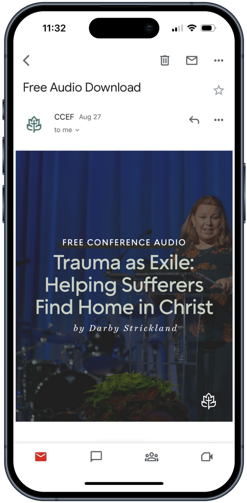
Sign up for our weekly email and receive access to a conference talk by Darby Strickland on helping trauma sufferers find home in Christ.
Loading form...