Christian Counseling & Educational Foundation
1803 East Willow Grove Avenue
Glenside, PA 19038

Todd Stryd
April 20, 2026
What does it mean to mentor someone well? In this episode, Gunner Gundersen sits down with CCEF faculty member Todd Stryd to explore mentoring as a long-term, relational investment that shapes both the mentee and the mentor. Together, they discuss how mentoring provides clarity, fosters growth through both encouragement and critique, and ultimately becomes a place of deep dependence on God.
Mentioned in this episode: Registration for our June courses is now open! One key course that features opportunities to grow in mentoring skills is Helping Relationships by Ed Welch. You can learn more and register at ccef.org/school.
00:00 Why Mentoring Matters (and a Resource for You)
01:21 Meet Todd Stryd
04:35 What Is Mentoring, Really?
07:17 The Hidden Power of Imitation
09:34 Formal vs. Informal Mentors
13:21 Why Encouragement and Critique Both Matter
21:32 The Foundation for Hard Conversations
23:51 How to Give Hard Feedback Well
24:20 The “What” vs. the “Why” in Growth
27:45 Why Mentors Grow Too
28:45 Imposter Syndrome & Trusting God
30:03 Final Encouragement: Step Into Mentoring
Hello and welcome to our CCEF podcast, Where Life and Scripture Meet. My name is Gunner Gundersen and I have the privilege of serving as the Dean of Faculty here at CCEF and I’m excited for the conversation we’re going to have today with one of my fellow faculty members here. Before we begin, how do we grow in walking alongside others? This question is at the heart of our online course, Helping Relationships with Ed Welch. Whether everyday friendships or formal counseling relationships, you'll grow in your ability to listen well, know people deeply, carefully and wisely apply Scripture to their lives, and offer biblically based truth that will motivate others in their growth in Christ. We hope you'll join us this June term. Registration is open through May 19, but register by May 5 for the early registration discount. You can learn more and register at ccef.org/school.
Well, I'm really glad to be joined today by my friend and colleague here at CCEF, Dr. Todd Stryd. Todd, thanks so much for joining us.
Thanks, Gunner. I am glad to be here.
We're going to be talking a little bit about the art of mentoring, and we'll explain just why in a moment. But Todd, could you just introduce everyone to yourself? Give a little bit of your background, your education. Tell us about your family.
Yeah, I'd be happy to. So it's been about 20 years that I've been at CCEF. And I would say what . . . 13 of those have been as faculty, and the rest as a counseling coordinator and as a contract counselor. So 20 years there. And my education, I started out with a bachelor's of fine arts and art education at Michigan State University. Then I went to get my Master's of Divinity at Westminster Theological Seminary. And then I did my graduate work at Immaculata University where I got my doctorate in psychology. And I'm married to Allie. We've been married for 22 years. And I have a 20-year-old son, Levi, an 18-year-old daughter, Delaney, and then my youngest son, Luke, is 15.
That’s wonderful, Todd. So do you consider yourself a Spartan?
Yes, I do bleed green, as they say.
For those of you not in the know, who were wondering why I just referred to Todd as a Spartan: Michigan State. So you're also anti-Michigan, I assume.
Yeah, my animosity has lessened over time. I've learned to appreciate all good colleges in the state of Michigan. Yes, Michigan State is the prime example of a good university.
I appreciate the effort to build some unity and not lose podcast listeners here in the first three minutes.
The reason why we’re having this conversation and why I was really grateful that you joined us for this . . . One reason I'm excited to have you personally here, Todd, to have this conversation about mentoring is since I've come to CCEF, I've consistently heard testimony about your helpfulness as a mentor. And so in addition to your experience in counseling itself, you also have been very helpful as a kind of in-house consultant to other counselors about the work that they're doing, as well as a helpful mentor to students who are learning how to counsel within our programs.
And while that's one specific format in which that mentoring has taken place, one particular field, if you will, the principles are really expansive and they can apply kind of across the board to how we seek to help others. So again, I'm really grateful for you to be here for this and this particular topic. As we dive into it, I'd love to chat for a little bit about what is mentoring. Could we talk a little bit about what mentoring is before we talk a little bit about the “how” and some other things?
Yeah, this topic really has allowed me to step back and think about that very question a bit as to what differentiates mentoring from counseling from discipleship. And I think some characteristics of mentoring would be that it is often built upon a longer term relationship where there's some degree of commitment over time that the relationship is going to be functioning through. That it's not a one-off, it's not a consultation, but there's a commitment from both parties or at least an assumption that we will be around each other enough and in proximity or a commitment to each other enough that we can continue these conversations and these engagements and these even consultations. But it's built in this package of a longer term relationship with some degree of commitment to each other.
Yeah, so I'm hearing there these kind of categories of time, proximity, and commitment that really helps provide a lot of the impetus for that relationship and brings about so much of the fruit of it. As I think about some of these words, obviously there's different words that are used both in Scripture and in any given culture for this kind of relationship. And I think kind of discipleship or disciple making as this whole life training in pursuit of Christ-likeness. Counseling might be more focused on problems or struggles to address or overcome. And sometimes people talk about the relationship between biblical counseling and Christian discipleship. And I think it's fair to say biblical counseling is a subset and a stage in some ways of Christian discipleship, but it's certainly not the whole thing. And there's other really robust discussions about that in other places. We really wanted to focus on this idea of mentoring and as you said, this kind of relationship over time in proximity that enables wisdom to be passed along from one to another. I tend to think, too, of mentoring as something where it might be often related to particular roles or responsibilities or seasons that a person is in where they need a particular kind of wisdom or insight or example for that role or responsibility that they have. And that can prove so helpful as people attempt to live out particular aspects of their vocation.
Yeah, and Gunner, something that sort of has struck me as a sort of a feature of mentoring is that when mentoring happens, it's usually connected to some degree of imitation. We see someone who has a skill, or a virtue, or a characteristic, or a role that we're interested in imitating, and that usually is the impetus for a mentoring relationship, and that then immediately connects to 1 Corinthians 11:1 where Paul says, “Be imitators,” or “Imitate me as I am an imitator of Christ.” And so there's like a sort of a creational feature here of how mentoring is just built into the way that we develop and grow in advance. And it is often connected to us noticing someone who has a skill set, a virtue, a characteristic that we're interested in learning and growing and imitating that.
That reminds me that there's this dimension of seeing and watching and being impacted by someone, perhaps in whose footsteps you'd like to follow in various ways. But then that person at the moment could be at more of a distance from you. You might not necessarily have that relationship or that proximity or that trust. And mentorship is when you actually get to have that proximity begin to develop and you get to spend that time and that kind of relationship develops. It reminds me of a quote from Howard Hendricks where he would say that “You can impress people from afar, but you only impact them up close.”
And that's where you go from being impressed by someone to being more personally impacted and shaped by who they are. Could you talk a little bit about your own experience being mentored and how this became something that was tangibly valuable for you and where you experienced that?
Yeah, it made me, again, this topic made me think about some of the . . . some of the different ways that mentoring happens. And you mentioned both the proximate and the observable. So I thought about it a little bit as sort of the formal mentoring and informal mentoring, in that there's a lot of people that we can observe and notice through stories and sermons and YouTube videos or the TV that they have characteristics or skill sets that we want to emulate. And so there's an informal mentoring that happens that the person has no idea that I am being mentored by them from a distance.
But then you have these more formal arrangements in relationships where there's a clear sort of commitment to each other or a contract of sorts. It's those formal ones . . . I think of probably first off, some formative ways that happened for me at Michigan State University in Campus Crusade for Christ. They have a very structured and intentional way that they go about discipleship, which often has these very close mentoring type aspects to it. That was really formative. At the same time as being a part of a university church where I was invited into sort of a small group with a pastor, some other young men, where there was an active mentoring.
And then I think the other place I would think about some of the formalness is in my graduate training program, they build in mentoring type relationships with supervision at my internships, my practicums, and those close watching and observing and being taught and evaluated, those types of relationships were extremely formative for me.
Todd, can you think of any particular moments that might stand out in one of those relationships where it might capture a little bit of the benefit for you, why that was valuable, how it became impactful in your life?
That's a great question. And I think what really showed up in my graduate level training is that it is part of the package of mentoring, part of the responsibility of a mentor is to give both positive and negative feedback, or let's say a positive and a negative critique. And that was one of the most . . . It's one of the most important parts of the mentoring process is having someone who knows, who has some expertise, some skillfulness and some commitment to me that they're willing to point out something that is negative or that needs to change that I need to adjust and grow in. And that really was the first time where I saw I experienced and saw experience. That was one of the first times where I saw how a negative critique or a feedback package like that was essential for my own growth and development. That positive feedback was also important and I loved that, but the negative was essential for me to sharpen my skills and to become who I needed to be.
It's powerful when you're in those relationships where the affirmation means so much because you respect this person and you see where they're at on the path. You may see where they're at, not only in their character, but their vocational skills as well. And they're telling you that they see something in you. They see God doing something in you. They see a gift that's been invested that you ought to be using. That's really encouraging. And at the same time, as you said, the kind of relationship where they can point out ways that you need to grow, make sometimes broad observations about general best practice in that particular field or activity, but especially when it's personal and they can point something out, but you know that they care about you and you know that they have your best interests in mind.
It's genuinely constructive. It's meant to build something into you that's positive, but it's also an insight that you might not have realized until 10 years later when you had to learn it only by experience and failure and seeing the side effects of your actions at someone that can actually point that out. And that's really a powerful experience to receive not only the affirmation, but the helpful critique.
Yes, Gunner, the package of both of those, it's really an essential part of that mentoring. That's part of where mentoring pushes us, I think, to accept the fact that that's, that is part of the calling that, “What I have received, and what was helpful for me, I also have to embrace as part of the calling upon myself, being both willing and able to see the blessings, the gifts, the successes, the victories, but also to do the hard work of pointing out where things are going awry or where there needs to be change, where there is a misstep, where there is an impairment, a lack of a skill.
So that is an essential coupling of those two. And I know that you yourself have had enough of a history in ministry and pastoral care, that there's a number of people that have represented that for you and your journey as well.
Yeah, I think discipleship has been a huge part of my life. And at times that's been more particular in the realm of mentoring on a certain skill or a certain role, vocation, and I'm pursuing, but it's had a profound influence on my life.
We have these staff prayer times at CCEF and often someone from the faculty or staff will share a devotional. And recently I decided to share a devotional that was a little bit of a story where I just shared about what turned out to be 12 men who have invested in my life in ways that have cumulatively been transformative. Each one of them has had a significant influence and it's been transformative, but collectively it is a really significant cumulative effect. And I'm really grateful and I could put up, and I did put up their pictures with their names and then four to five bullet points of what I took from each of them.
And the Lord brought them along at different seasons of life. The focus of what we might have talked about or what I might have been going through would be slightly different for each of them. And what I learned from each of them was different. But one thing that really hit me, I think looking back on that kind of long line of faithful believers in my life was the combination of similarities and differences, where there are core aspects of who they were and who they are that drew me to them. And that was consistency, character and integrity and love for people and an availability to care for others.
But then also there were a lot of differences and I could look at each of them on that slide show I had put together and see how different they each were as well. And to realize that each of those differences that the Lord had wired into them, he was using in my life to impact me. And that gives me a lot of comfort when I start to wonder how effective I can really be with my different proclivities and idiosyncrasies, and I don't have this or that skill that someone else has around me. It reminds me that the Lord has used many different people in my life. I want to turn around and ensure that I'm part of this business of passing along what the Lord has invested in me. And so, yeah, that history makes me incredibly grateful.
It was a powerful testimony for you to share that, for us to see the faces of those men and for you to tell those stories. It was powerful.
Todd, we talked a little bit about the importance of affirmation. Could you talk a little bit more about that affirmation encouragement in the process of mentoring?
I think it has a really profound orienting characteristic to it. If we think about parenting, think about teaching, pastoring, counseling . . . The importance of edification, of affirmation, of validation of what we are seeing in our children, in our counselees, in our flock, that is essential. It's a way in which the people in front of us get some clarity as to who they are and how they work in the world. Otherwise, they are left guessing, they're left filling in the narrative of what they're good at, how they fit, how important they are. So just like in parenting and counseling, mentoring also entails this affirmational, validational encouragement that when a mentee is growing, is accomplishing, has a skill set, is showing integrity, as we watch a recording of their counseling and they're doing a good job, it is part of our calling to highlight that, to amplify that. What it does is it grounds them into an understanding of themselves and where they can find some confidence and feel some competence, but also then potentially where they can grow. But all growth, most of the growth in our negative critique or feedback, that's going to have to be built in the foundation by which the positive affirmation, encouragement, and validation comes in. Because as they're established and grounded, as they understand what they're good at, what they're not good at, who they are, how they fit, that is going to be essential for them then to build. And that is our job as mentors to help establish that: How they locate themselves in the world, in their relationships, in the relationships with God. In a sense, think about it like this, that we are essentially saying you can have confidence because I see what is happening and there is, there's evidence of this. And then there's, they have some confidence in the fact that they either know what they're doing that they're showing up in proper ways.
So pointing out those evidences of grace is really critical as an orienting dynamic in our lives to hear where others see the Lord at work in us, where others see where he's gifted us, where others see what a helpful, fruitful pathway might be for using our gifts. I appreciate how you said too, Todd, that not only is it orienting in and of itself, it also is a very needed foundation for corrective conversations or constructive critique to know that someone is doing this because they see and they value who we are and what we're able to contribute.
I remember when I was a resident director in college ministry, one of the hardest conversations to have was when in the first few weeks of school, I had to approach a student who was new to me, either brand new to the school or who had come over from another dorm, so was brand new to my dorm. And I had to talk to them about a policy violation or some concern that came up that out of responsibility and care for them as a student, I needed to talk to them about. If we had not had previous interactions, it just made that conversation far more delicate, far more complicated. And I really had to wade into it in a different way. Whereas if I had a longer term relationship with a student that had been there for a couple of years and we'd been able to have some meals, I was able to share some encouraging words. We talked about other spiritual things. And then I watched them lose it on the intramural basketball court and try to lovingly pull them aside and help them process that and think through maybe going back and apologizing to the referee for the nasty things they said, because by the way, that guy also lives next door to you. That was a very different conversation when we had some history and we had some positive encouragement and we had some of that time. And that's what I'm reminded of when you share . . . not only how important affirmation is, period, a gift of grace from the Lord through us to others, but also how it is laying a relational foundation for some other conversations that are not less important, but they just have a delicacy to them.
Yeah, it really is foundational. I like your word: “orienting”. Affirmation and encouragement is, it locates and it orients.
Can we talk a little bit more now, Todd, about how do you try to go about offering that kind of constructive critique? Are there things you're trying to guard against? Are there particular ways that you've learned to share that or ways of setting the context in a way that's most helpful? What are some of your thoughts there? Because that's such an important part of mentoring, but for anyone involved in those relationships, it's a sensitive thing to do.
So Gunner, where that takes me then is in mentoring, it's often that we will start with the concretes. Most of the time we start with the concretes of what it looks like to move forward or what kind of options we have to do something in this situation. But then that also opens the door for a broader conversation about what is happening inside my head. What kind of framework am I working from? What kind of principles are at play? So that's the framework that I think of when I work towards the mentoring endeavor, is both the “What do I do next?” and “Why do I do it?”
It's a bit of the external internal is what I'm hearing is you're sharing. There's a sense of I need to help someone think through what's going on out there and what is wise to do about it. But then also what's going on in here. What is the internal processing? What are the reasons? What are the rationales? What are my own perhaps motives and fears and hopes and how does that affect what needs to happen? And so kind of the internal why, but also the external how, and “What do I do?” Even those categories can prove really helpful to someone that's just in the mix of a new ministry or a particular role that can be complicated or heavy where we can, I think, whenever we're new or under duress can get very hyper-focused on something and lose our way a little bit. And mentoring can help provide a little bit of a refresher on that map of where are we at? What is a wise step forward, a wise direction? And then why would we do that? Why would we go that way?
And Gunner, maybe I’ll add this. One of the beauties of having the opportunity to mentor is that it really becomes this sort of crucible of sorts, because it's a litmus test as to whether I actually know what I'm talking about. And over the course of time in mentoring, I have come face to face with things that as I try to explain it, or try to give advice or help a mentee think through something, I'm just hit by the fact that I don't know what I'm talking about here. And it then drives me back to the thinking, the praying, the writing, the processing, because the chances are if I can't explain it, if I can't guide my mentee, through this, there's a chance I really don't know what I'm doing myself. So it is a humbling and yet sharpening process to be forced to consider as I'm helping my mentee: is my conceptualization, is my understanding, is it up to par? Do I know what I'm talking about?
Absolutely. It's so easy to, from the outside looking in, picture a mentoring relationship and think, here's the person with all the answers and here's the person with none of the answers. And this person with the answers will give the person who doesn't have the answers the answers and then off they'll go. But as you said, so often as a mentor, you're learning just as much, if not more than the other person because you're attempting to teach and you're bumping up against some of the limits of your own. experience or the models that you've used or assumptions and you're able to reevaluate and keep learning.
What I hear you saying there too, and we'll close here, is there is a real sense of humility and dependence in the process of being a mentor. It's not just this, I walk in with confidence and only when I can walk in with confidence and know that I have everything that I need at my disposal to deliver the goods to this person, can I do this. It really is a very humble and humbling endeavor. Can you talk just a bit about that as we wrap up?
It's a great place to sort of wrap this up because I would say it's a big portion of where God is currently sanctifying me. If it was up to me, I would just rather choose to blend into the background. There is a constant imposter syndrome that shows up in this process for me. So part of what I feel God is telling me in his calling is in faith and in trust, just step out in this role and trust me that you're not an imposter, that you're not gonna be alone in this, and that he is sovereign over the development and the maturing of my mentees. And it's not all on my shoulders and all in my hands. And he affirms and confirms that this is the right path. But it's a crucible of trusting even when I don't feel like I should be doing this.
Well, I just want to express, on behalf of many, our appreciation that you have pushed through that imposter syndrome, that you've continued to invest in the mentoring process and continue to bump up against your limitations, whether real or perceived, and continue to help others grow in their roles. Thanks so much for joining me, Todd. And for those of you listening, I just want to encourage you to be in the business of seeking this for yourself or offering it to others. It is a place where the Lord meets us, uses us, grows us, stretches us, and we become more like him. Thanks again for joining us on Where Life and Scripture Meet.

Faculty
Todd is a faculty member and the counseling coordinator at CCEF, where he has served since 2005. He holds a doctor of psychology from Immaculata University and a master of divinity from Westminster Theological Seminary. He has experience as a hospital chaplain, crisis worker, and university counselor. He has written a minibook entitled Schizophrenia: A Compassionate Approach.
Todd Stryd's Resources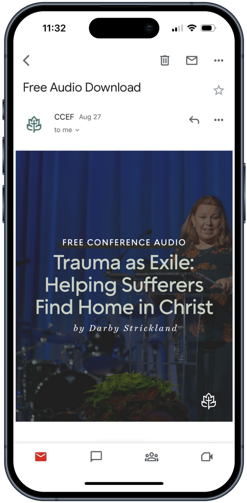
Sign up for our weekly email and receive access to a conference talk by Darby Strickland on helping trauma sufferers find home in Christ.
Loading form...