Christian Counseling & Educational Foundation
1803 East Willow Grove Avenue
Glenside, PA 19038

David Gunner GundersenEd WelchMike Emlet
November 2, 2026
We all want to be loved, accepted, and approved of by others. But when that desire becomes something we need in order to be okay, it can begin to shape our relationships, decisions, and even our obedience to God. In this episode, Gunner Gundersen sits down with Ed Welch and Mike Emlet to revisit Ed’s influential book, When People Are Big and God Is Small: Overcoming Peer Pressure, Codependency, and the Fear of Man.
Ed shares the story behind the book and how his exploration of the codependency movement led him to discover the rich ways Scripture speaks to our longing for approval. Together, they reflect on personal experiences with people-pleasing, consider how our desires can become demands, and explore how the fear of man shows up in everyday relationships. They also discuss practical questions that help uncover what we're looking for from others and how we can grow in love. Ultimately, the way forward isn't simply greater self-awareness, but a deeper knowledge of Christ—one that turns our attention from ourselves and others toward the beauty and greatness of God.
Mentioned in this episode:
00:00 When Divorce Is Mercy: A New Resource
01:17 The Story Behind When People Are Big and God Is Small
02:06 The Codependency Movement and the Search for Biblical Answers
04:10 Ed's Early Experiences with the Fear of Man
07:51 Recognizing People-Pleasing in Our Own Lives
11:43 How the Fear of Man Shows Up in Everyday Relationships
13:59 Moving Beyond Labels to Understand Our Hearts
16:01 When Desires Become Needs
18:31 From People Pleasing to Anger and Jealousy
19:25 Finding Our Way into Scripture
21:40 Learning to Love When It's Difficult
25:43 Does Love Trump Self-Interest?
28:14 Questions That Reveal the Fear of Man
30:18 Do I Want to Love More Than I Want to Be Loved?
31:10 Helping Others Look to Christ
33:35 The Beauty and Greatness of God
34:56 From Self-Awareness to Worship
Hello, and welcome to our CCEF podcast, Where Life and Scripture Meet. My name is Gunner Gunderson and I serve as the Dean of Faculty here. I'd like to begin by introducing you to an important new resource. As we know, marriages are meant to last, so when a marriage is devastated by betrayal or desertion of various kinds, painful questions naturally follow.
What does faithfulness look like now? Should I stay? Am I biblically free to leave? Even if I am free, what is wisest in my situation? These questions are complex, and that's why we're grateful for the recent release of a new book by Michael Gembola and Darby Strickland. It's called When Divorce is Mercy: Finding Biblical Answers to Questions You Never Wanted to Ask.
This book looks to Scripture to offer careful wisdom to suffering spouses and the pastors, counselors, and friends who walk beside them. As readers consider the teaching of Scripture, assess the impact of the offenses, and look for repentance and change, Gembola and Strickland will encourage them to trust God's compassionate leading for each faithful step. You can learn more at ccef.org/book.
Well, I'm glad today to be welcoming two colleagues to the podcast. Ed Welch and Mike Emlet. Thank you, gentlemen, for joining me.
Gunner, Good to see you.
You too, Ed.
Michael. Michael, good to have you with us, too.
Thank you. Glad to be here.
Great to have you both. We are here today to talk about the topic of people-pleasing and the fear of man. And we're doing this and kind of a group informal interview discussion with you, Ed, about your influential book, When People Are Big and God is Small. The subtitle is: Overcoming Peer Pressure, Codependency, and the Fear of Man.
Can we just start this way? Can you just talk a little bit about the origin story behind this book? When people are big and God is small, you know? How did the idea first come to you? How did it develop? Really? What's the heartbeat of the book?
Well, we all the struggle with the fear of man, but you just assume that that's the way it is to be a human and you live with it. So that was not necessarily calling my attention any more than it always had. I think it was really a cultural issue, something around us that captured my attention. And it was the codependency movement which we still here today.
But it was roaring in, in the 1980s, and, and and what I found in the codependency movement were two things. One is obviously it identified something really important that everybody experienced. We need other people to make us feel okay. And that struggle to be approved and liked is in all of us. So it identified that and described it really very well.
I think what captured my attention, though, was the answers to it were so superficial. Excuse me for saying this, but there were variations of loving yourself. And I think perhaps the illustration that that fired me up was, was it said something like this, it said, “There's a way to love yourself. Why don't you just get naked and stand in front of a mirror and tell yourself how good you look.”
And at that particular time, at least, my own thought was, okay, this has gone off the rails and this is an ineffective way to to help. So really it was that movement that captured my attention. And the question was, okay, well, how do we get into Scripture? It doesn't use the word codependent. So that was sort of the treasure for me.
How do we get into Scripture from that particular word? Because it's got to be there. Scripture has to speak about this, and it has to speak about this profoundly. How do we do it? So that was really the origin of it.
You know, at the start of the book, Ed, you talk about your high school awards ceremony. Could you just briefly share that story, and we'll talk a little bit about some of our own personal experiences with the fear of man and people-pleasing?
Yeah. Once, you know, once I settled on the topic, obviously, it begins with, okay, where do I see it? So some of those old stories that stood out, they, they, they not only came to remembrance, but they, they, you know, 20 years later, I'm thinking, am I any different from this person in high school? I'll tell you two stories real quickly:
The one of the awards assembly, it was a sport awards assembly, and they were going to give out these sporting awards. And so they got to the sport that I was involved in and, and I found myself thinking, ay-ay-ay, I, I don't want to make a fool out of myself by walking up there and tripping over myself.
And I think they expected you to say just a little something. And I knew I was going to stumble. And so I was thinking, oh, please, I don't, I don't want to be called up for this award. And then they called the award and it wasn't me. And then, of course, my mind went to what a loser I can't believe it.
And I'm going to go back into classes and everybody's going to know,
“Oh, there's the loser. He didn't get the award.” I think what captured my attention was, oh, yeah, this is very familiar stuff. But you can't win. You can't beat this. You get the award. And you're a loser because you didn't. You said something stupid after you got it or you didn't get the award.
So I recognized at that point that this sucker really is a trap. And how do you get out of it? But it was just in the back of my mind. And because there was really no way out of it. So I just became aware of it. There was a there's another story to around the same era, a different, different genre, but it also captured my attention where I didn't know where to go.
But I said, this is unusual. How do you, what do you do with this? And it was a time when I was, I was, I liked this other girl. I think it must… I can't even remember the details, but I think there was a date that night, and the date didn't go very well.
And the relationship was over before it started. And my mother was awake when I came in, and she, she discerned that something wasn't right with me. And she knew that there was some sort of date going on. She recognized it had to have something to do with that. And she said the most beautiful things. So insightful.
She said, she said, “Eddie, I love you. I want you to know that I love you.” And at that moment, I, I had these these two thoughts: “It doesn't matter.” I was thinking it was thinking in my mind, “Mom, it's…I'd rather you love me than hated me. And I'm sure it's a really good thing that you love me. But at this particular moment, it really doesn't matter at all. Because you're not the person I want to love me. I want this other person to love me.”
So those were two early incidents that I found myself reflecting on as soon as the codependency material took me further in and I said, okay, yeah, there it is. And I can still find it today.
Now, “Okay, Lord, speak. Scripture has to be a whole lot richer than than what I've seen it to be so far.”
Let's continue on this theme of just some personal ways that, you know, we've seen the fear of man or people-pleasing in our own lives. I know for me, I think I first discovered my own fear of man at 16 years old, when I just suddenly became aware that I was constantly thinking about what other people thought of me and whether or not they noticed me.
And I think it was, it was definitely more than kind of your standard teen self-consciousness. It really was, as I became aware of it and went deeper into it, this sense of just blatant self-idolatry. And one of the problems that I faced is I realized that I, I didn't know the Lord and I wasn't concerned about him was, as you mentioned, there was this inescapability to it.
It felt like whatever situation I was in, I could think that way and I could be consumed by these thoughts. And so really, the fear of man for me was really this deep-seeded stronghold sin that God used to convict me and then to really create what was for me a brand new sense of just desperate need for Christ.
It would have been the central, maybe “pillar sin,” if you will, in my life that the Holy Spirit convicted me over, which I'm so grateful for. And although the awareness of it then began to be helpful, I also have started to realize moving into college and beyond that there were so many layers to this that I never would have dreamed I could have seen and needed to be freed from when I first encountered it at 16.
Similarly to me, I mean probably junior high, high school. A couple of things that I noticed: one was that I was kind of the, I was kind of the class clown and it was a, it was a way to, you know, deflect in some ways deflect personal, deep interactions while in a sense garnering attention.
Right. I was always I felt always like I was on the edge of the in-crowd. I was never in the in-crowd, but it was a way to be close to the in-crowd. And then a few years later, I remember a high school friend talking to me, and she said something like, “You know, you're always you're always serving, you're always doing for others, always asking questions about others, but you never really talk about yourself in a sense of letting us get to know you.” And that was a, yeah, a revelation to me in terms of still, maybe I wasn't in the class clown mode then, but it was… I was actually using my questions and my service of others as a deflection. Like, I don't really know if I want to be known by others because what will they think?
Mike, you, this isn't exactly what you were trying to get at, but my first thought was, “Wow, so cool that he was the class clown. I just didn't want to be seen or known. Well, Mike, I would love to hang around with Mike in high school. I think that's so cool.” And then to add the maturity of actually being interested in other people, I would have been thinking, “Who is this guy? This guy is really cool. I want to get to know him.”
So I would have been a good friend for you because those areas where you could see your own, your own fragility underneath it, I would have given you all kinds of kudos. I would have said, “This is great.” I wish, I wish, I wish I did those things.
We have Eddie and the class clown. So we're off to a great start today.
I'll give something more recent, two things, one is throughout my marriage, I would say that the challenges that we would have would be around “My wife doesn't think I'm great. And isn't that what she's supposed to think? And what a loser that I am.” That would be at the heart of a lot of our conflicts and sometimes would be…it wouldn't be me lashing out, it would be me just sort of sulking and turning away when somehow I was a disappointment or less than what I thought I needed to be for her. The second thing that would get me would be student evaluations at the end of teaching. So I can remember I’d get these teaching evaluations, and I wouldn't want to look at it for two days because I knew I knew there was going to be a cost to pay every time I went into them.
And sure enough, there were, I'm sure some of them were nice, but the ones I remember are all the ones that, that spoke about how disorganized the classroom was. So those were the more recent ones. And by the way, what you're guiding us in is, is if we can't describe it, then, then we're not going…then Scripture is going to be somewhat meaningless where Scripture speaks.
We're not even going to notice that it speaks until we can put words onto these things. And that's in many ways the way out is to do exactly what we're doing right now, to find these illustrations. But here's the challenging thing: to speak these things to the Lord, to actually speak them to the Lord rather than deal with them within our own hearts and just get immersed in them to speak them to the Lord.
That's the beauty of what Christ has given us. Now, that's just the beginning. But that is such a powerful beginning, the things we're identifying right now, we have a place to turn with them. We don't know what the Lord will say necessarily, but we'll say, “Okay, Jesus, help. Here's what I'm going through. And it's got to be different than this.”
And I've heard you say that if I only have one name for something, I might not know what I'm talking about. Meaning, if I just have a label, if I just have what can become a buzzword like a fear of man, people-pleasing, there is a depth to it that I might not access. And I've found, as you said, that as I just slowly learn to name these things to the Lord, to talk to him about them, and ask him to speak to me in return, through His Word, by His Spirit, I develop more of an understanding and more of a fluency in what is actually going on in my heart.
And even more important than that, a greater understanding of how different aspects and attributes of who he is and what he's doing in my life and how he's designed relationships really, truly to work in their best way. Those things become far richer for me, and I think you do that so well in the book as you unpack this with a depth of experience and then ask how Scripture speaks into that with its own profound riches.
And I think that is so much the impetus of this conversation to is to take something that can just live right on the surface of a label or a statement that “we all struggle with fear of man,” in some way, shape or form, and go deeper into unpacking that and ask how the Word goes deep with us.
Yeah, yeah, I think that specificity, is really important. You know, like I would say one of the through lines for me is I don't like conflict. You know, I, I want, I avoid conflict. And so what is that why is that and how does that how does that connect, if you will, to that umbrella idea of, of fear of man?
But it's very specific. It comes out in very specific ways. And how does the Lord speak into those particular situations where I'm avoiding conflict or avoiding a conversation, or I don't want to raise a difficult word, or I don't want to be vulnerable myself to go back to an earlier manifestation.
For me, some of that specificity actually came from the codependency movement because the word “need” would come up. You need the other person. You need the other person to accept you, to like you so you feel like somebody, you, you, you must have their, their acceptance or their approval. I did find that to be helpful. So in my relationship with my wife, it… okay, do I want my wife to like me and, and think that I am on the better end of husbands and she made out decently in the arrangement? Do I want that? Of course I want that. Who wouldn't want that? But that word “need” was very helpful. “No, I need this. This is my very life. I need my wife to approve of me. And if she doesn't, then my world starts to fall apart.”
That word “need” was one of the words that began to move me into scripture. You can. You can see idolatry is right next door to it. I must have this in order to live. And all of a sudden we go to something like Jeremiah 17, which has been sitting around forever.
And there's two paths. It takes, takes those two paths of Proverbs and, and, and uses this label: you will either trust in man and other people or you will trust in God. And one will…you’ll feel like your soul is dying, the other, your soul will be replenished no matter what season it is. So I think for me it was the word “need,” in other words, came after that.
I need to be somebody. That was a phrase that, that, that really stuck with me. But that word “need,” it moved to things I need are the things that I trust him, the things that I worship, that I must have in order to be okay. And here I am, what an ordinary heart? What are the things we trust in?
We trust in, in things that give us pleasure, we trust in our money, and we trust in other people. Why do we trust in those things? Because we believe that they're going to give us what we need in order to live. They become substitutes for the Lord. So the specificity of the word “need” was, was a helpful one for me.
Yeah. That question: Not just what do you desire or what do you want, but how that starts to morph into a grasping. I must have this, I need this. In fact, I'm demanding it. Which is sometimes why there's a teeter-totter between, you know, people-pleasing and anger, you know, because all of a sudden, I haven't you haven't given me what I want and need and desperately, have to have.
And jealousy, which Proverbs seems to suggest that that's the big nasty one because it's, it's just it's such an ugly feature of the heart because this other person has the things that I need, that I deserve. And, and so all of a sudden we begin to break relationships because of this, this, this idolatrous desire to be approved.
What are some of the realities, truths that have helped each of us personally as we engage these issues? It might even be particular practical things. What has been helpful to us?
Well, for me, just seeing this thing…when I think of what may have that book on fear of man contributed it was okay, it doesn't contribute to the description of these problems. We've all had the description, but it's how can we find this way into Scripture. So for me, the, the way in was idolatry.
That was, for me that was a powerful word at the time. And it continues to be a powerful word. It captures what it is that I worship. So that was very helpful. Jeremiah 17 was helpful when I encountered it, I think. I think seeing the Pharisees in that light was helpful. John 12: they love the glory that comes from man more than the glory that comes from God, which is striking. And there's a glory that comes from God that we can experience. But they love the glory that comes from man more than the glory that comes from God. So, so for me, what the Spirit does is he captures my attention and all of a sudden I see Scripture identifying this. So where does that lead? All right.
There it is. But I still feel the snare of it all. “Jesus help, I see it. Now what?” By the way, I think after that, everything is easy. It's being able to turn to the Lord and say, “Okay, my eyes are open. I have no idea what to do, but that's, you know, Scripture will help us. Other people can help us with it. The Spirit will certainly guide us into places.” It's that initial turning to Jesus and saying, “Okay, I really need you in the midst of this.”
You know, I mentioned my conversion at age 16 when I became aware of this. Then I went off to college and when I got involved in student leadership in college, was when I started to develop some responsibilities. And one of those would have been enforcing policies with my peers in the dorms and…
With your peers. That's an interesting one.
Yeah. And so I had to, you know, find people if they kept the the hall vacuum in their room and nobody else could use it, or I had to, you know, talk to them about various things that might come up, often small things, but also because we really were trying to have a community discipleship-oriented environment. Also, if there was a concern, if it seemed like just someone was forming a really unhealthy, inappropriate relationship, to ask questions and to try to care for them.
And I remember that there were certain semesters where I would have this small stack up of needed conversations that I had not had yet, but I also had a strict conscience that was like, you're not doing what you should and caring about this person if you don't take care of this. And I just realized through that process how much I just simultaneously knew that I had this calling to pursue and care about them in these particular ways, or address certain things, that I had a responsibility, even to my superiors, to, and therefore to the Lord.
And yet how desperately I also wanted to avoid them. And that was such an important process for me to have that sense of both responsibility to care for others, and then to have that responsibility compel me to deal with all of the, all of the kind of swirling fear and concern, sometimes feeling like it reached a crisis level in my own heart.
That was really significant. And I think what the Lord began teaching me through that was when you're afraid of what people think about you to the point that you're not doing what's faithful, there's a fundamental failure of love. There's a self-love that is really rooted in your heart. And I'm so grateful for some of those early callings.
I transitioned from that as a student into a ministry in the dorms. Now as a full-time staff member, and continued to need to wrestle through those same things. What does it mean to just love faithfully in difficult situations where I feel like my reputation, or a sense of peace and comfort in the relationship, people just all being okay with me?
I felt like I was in jeopardy! And yet to be faithful meant that I needed to, in my own heart, risk that and trust the Lord and learn how to to love and have my attention be focused on them and their good rather than me and what they would think of me. Those were just very important early years for me.
Not because they eradicated the fear of man, but they just helped me to see the Lord's faithfulness in it, more of what was going on in my heart, and give me some templates and patterns for the future battles to come even.
Yeah, I think for me, a place where, you know, running up smack dab into, you know, people-pleasing fear of man was in parenting, you know, in terms of and you're highlighting this too, Gunner, in terms of, love trumping, in a sense, self-interest and self-orientation. And I think in parenting I was regularly faced with that, you know, will my love for what my children need at this moment propel me forward into a difficult conversation or, whether it's a difficult conversation where I'm needing to point out something in their lives or whether I'm having to confess my own sin to them, you know, will love trump this orientation toward towards self?
So yeah, that's one place where I've, where I've seen it, the Lord, the Lord work, but also plenty of room for continued growth, even as my, you know, children are now adults.
Appreciate a few different things you guys are raising. One is just that, again, that specificity, that carefulness and the way we think about these things. The fear of man, we can use that as a sort of a heading for this because Scripture, Scripture comes back to it fairly often. It comes out in things that you do and you start cursing, drinking, doing drugs because it will… you'll be part of that particular group.
You will be acceptable. You walk in the direction, not under the words of Christ, but to please other people. So you begin to take on their preferences. You dislike the people they dislike. So there are things that you did that were wrong. What both of you are identifying are the things you don't do. You? You avoid conflicts.
You avoid the hard conversations because you will be the bad guy, perhaps, in some of these things. And it's going to be more difficult before it gets better. So I appreciate the specificity you're bringing there. The other is, when we come to the Lord with these things, and let's say what we haven't reformulated is the fear of man, which is really a nice stepping stone in Scripture, it gives us a lot of different Scripture, all we need to do is go to the great themes of the Bible, and it gets us where we want to go. Okay? It's about loving the Lord with our whole heart to be able to say to the Lord, “Lord, you are great, you are great, or to go back to Jeremiah, which Paul picked up: “If you're going to boast, boast in this that you know and you understand me.” So what is that? It's just different versions of knowing and loving the Lord. All roads tend to lead us there. The other one that both of you are identifying is the two great commandments. You love the Lord with your whole heart, and you love others as yourself.
And both of you are saying, the way the Spirit moved you through those places where the fear of man could capture you is this call to love. But did I love, but did I love? Yeah. Rather than how? How do I want to be loved in this situation? The call of Christ by the Spirit. How do I love?
And “Lord, give me, give me a boldness and a bravery in love. That's that's what compelled you.”
What are some questions that we might ask someone to help them get clarity about their own people-pleasing and how to think about it, how to grow in some of this awareness, which then, as we've shared, helps for Scripture to come alive and speak directly with specificity into. Qhat are some questions that you think can be helpful?
A bunch of I'll just I'll start with one. And it's that personal one from that old illustration. Okay. You really want this other person to love you, or you really want to be able to fit in? You need it. Does it matter to you that God loves you? Does it matter to you that you belong to the Lord? So that that question would capture it?
That's again, that captured my attention even as a younger, as a younger teen. Why is this? Why is it that my love, my, my mother's love doesn't matter to me right now? It should, but it doesn't. Well, that would be one question. Do the words of Christ and His affection for you and his tucking you into himself…does that make a difference? Well, if it doesn't make a difference, then we have a lot of good work to do.
Yeah, I, I think you're highlighting this Ed is in terms of when you see differentials in, in your relationships with people like these, the approval of these people matter. The approval of these other people don't matter. Why is that? Why is there a differential there? Because I think that's often true, right, in fear of men.
And you're highlighting this, that we really want their approval, their affection, their love and others that we, we don't care so much about. Why is that? What's the specificity there? So I think that's a question that can, that can get at some of those underlying desires, demands, needs yours.
Here's another one similar to that. This is a personal one, but I've asked it before, do I, do I want to love more than that? I want to be loved. In other words, of course we want to be loved. Of course we want to be accepted. How could we not? It's part of our very design, but do I want to love that person more than I want to be loved by the person? What we're looking for is love that is utterly invincible, that we can stand firm and turn toward the person even when they're not treating us the way we feel like we need to be treated. So I found that particular motto to be helpful.
Do we want to love more than we want to be loved?
And what would you say to someone that wants to help a spouse, a loved one, a friend who may be struggling with people-pleasing in the fear of man? How can we be helpful to those around us that perhaps want help or need help, or that we feel we have an opportunity to help?
Yeah. And Mike, I'll interrupt. I'll take the easy way in. First, when in doubt, we talk about who God is. So I've thought about this with my grandchildren more recently that when we're together, I want to speak devotionally. “Here is what I am learning about Jesus.” And it is absolutely amazing that, you know, that those kind of of very personal devotional words, that's, that's that's the way I went to address their own fear of man.
And they of course, they're human beings, so they all have it. Now, that's not using the phrase fear of man. It's not giving them new insights into it. But it is doing the very thing that gets to the heart of it. Do we believe that God is so great that we know, and we know him well enough to be able to even boast about them to other people?
That will, that will deal with the fear of man in our own hearts. So that's one way to do it without using the actual phrase.
Yeah. I was thinking similarly, Ed, in terms of, how can we help them set Christ before their eyes in such a way that they see, you know, his beauty and are drawn to him? I mean, one verse that I go back to not infrequently is Psalm 27 for, in terms of one thing, one thing I've asked of the Lord, this is what I seek after that I may dwell in the house of the Lord, the days of my life, to gaze upon the beauty of of the Lord, and to inquire in his temple. Where is my gaze? On the one hand, like, whose eyes matter? it's his gaze on me. But where is my gaze? And so this, yeah, that's one place that I go back to in Scripture not infrequently.
Yeah. And with others in preaching, teaching, speaking to grandchildren or children, whatever it might be to say, and here's the crazy thing, we being in the house of God, it's a good thing, but it seems like there are other things we want more than that. Yeah. Yeah. Who are we? Let's pray that this is what the spirit would give us.
Like I was thinking, I was reading something on the Psalms over the weekend, and it made this comment that what the Psalms do is they embed all knowledge and insight in wonder and awe and amazement. Who is this God who is the creator of all things? And he's actually made a covenant with us. Who is he? So that would be another way of talking about that particular psalm and, and even just keeping that vision in front of us.
I've also been thinking about doing this in our small group that here's where all growth and change takes place in the knowledge of God in Christ. That is where that is the treasure. He is the treasure. Now let's start telling stories about who he is and how we're knowing him in new ways that inspire and wonder us all.
This has been a wonderful conversation, and I think that's just the appropriate place to end. Not necessarily in a place of self-excavation, but of exaltation, not just with the self-awareness that is important, but with the worship that really takes our attention and puts it in a place that is most satisfying and brings God the glory that he deserves.
Thank you so much for the conversation, and thank you, Ed, for writing such a helpful book. We pray that it only continues to multiply and to spread and to help many others. And we just want to end this conversation by praising the One who has reached down to us and has rescued us from many, many things, but one of them being the fear of man. And we pray for that continued rescue until we see him in glory. Thanks for the conversation.
A pleasure. Thanks.
Thank you. Gunner.

Dean of Faculty
Gunner is the Dean of Faculty at CCEF, where he has served since 2024. He holds a PhD in biblical theology from the Southern Baptist Theological Seminary and a master of theology and master of divinity from the Master’s Seminary. Prior to joining CCEF, Gunner served as a lead pastor for seven years, after working for fifteen years in Christian higher education as a resident director, director of student life, associate dean of men, and biblical counseling professor. Gunner has a passion for helping believers live consciously in the story Scripture tells, equipping the local church for interpersonal ministry, strengthening pastors, and biblical preaching and teaching. He has published the Psalms notes for The Grace and Truth Study Bible (Zondervan, 2021), What If I Don’t Feel Like Going to Church? (Crossway, 2020), and numerous essays and articles on the Psalms and adoption.
David Gunner Gundersen's Resources
Faculty
Ed is a faculty member and counselor at CCEF, where he has served since 1981. He holds a doctor of philosophy in counseling (neuropsychology) from the University of Utah and a master of divinity from Biblical Theological Seminary. Ed is a licensed psychologist and has been active in local church ministry for decades. He has written numerous books, including When People Are Big and God Is Small (P&R Publishing, 1997), Shame Interrupted (New Growth Press, 2012), Side by Side (Crossway, 2015), and Created to Draw Near (Crossway, 2020).
Ed Welch's Resources
Faculty
Mike is a faculty member and counselor at CCEF, where he has served since 2001. He holds a doctor of medicine from the University of Pennsylvania and a master of divinity from Westminster Theological Seminary. Prior to joining CCEF, Mike worked as a family physician for eleven years. He has particular interests in working with ministry leaders and with those who struggle with anxiety, depression, and OCD. He has published numerous books, including CrossTalk (New Growth Press, 2009), Descriptions and Prescriptions (New Growth Press, 2017), and Saints, Sufferers, and Sinners (New Growth Press, 2021).
Mike Emlet's Resources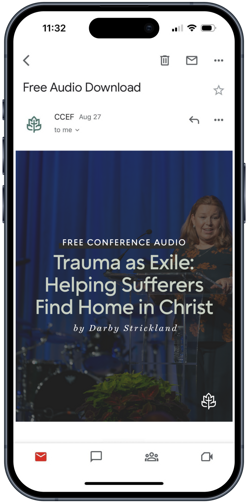
Sign up for our weekly email and receive access to a conference talk by Darby Strickland on helping trauma sufferers find home in Christ.
Loading form...