Christian Counseling & Educational Foundation
1803 East Willow Grove Avenue
Glenside, PA 19038

Aaron SironiDavid Gunner Gundersen
May 18, 2026
This is part 2 of a 2-part series. Listen to part 1 here.
Some of the most formative marriage counsel isn't found in a book, a technique, or a counseling session, but rather it comes from watching another couple walk faithfully with Jesus over time. In part two of this conversation, CCEF's Gunner Gundersen and Aaron Sironi explore Paul's surprising strategy in Philippians: imitation. Paul doesn't point to marriage principles but instead insists we keep our eyes on people who imitate Christ. Aaron also shares the rest of his story: how an honest "I don't know" in a conversation with a church elder launched him into biblical counseling, and what he's learned since about the deeper longings underneath many struggling marriages: Do I matter to you? Will you be there? Listen to a rich conversation about slow formation, counter-images, and what it looks like to have a marriage worthy of the gospel.
Mentioned in this episode: Register now at ccef.org/2026 for our CCEF annual conference before the price increases after June 16.
00:00 Introduction
01:19 Welcome & Episode Overview
01:42 More of Aaron's Story
06:27 How God Redirected Aaron Toward Biblical Counseling
08:58 Paul's Surprising Strategy: Imitation
11:42 Christ, Timothy, and Epaphroditus as Examples
13:14 Counter-Examples and Enemies of the Cross
15:40 The Shaping Power of Images (David Powlison)
19:36 What Mentorship in Marriage Actually Looks Like
24:37 You Become Like the Couples You Surround Yourself With
31:58 The Deeper Questions Every Spouse Asks
34:09 Closing Reflection: Loved Before We Are Called to Love
Hello and welcome to our CCEF podcast, Where Life and Scripture Meet. My name is Gunner Gundersen, and I serve as the Dean of Faculty here at CCEF.
Today we're honored to have back with us CCEF faculty member and counselor, Aaron Sironi, for a second part to our conversation from last time about marriage, and specifically, marriage insights from a surprising place: in the book of Philippians. So Aaron, welcome back. Thanks again for joining us.
Thank you, Gunner. It was fun the first time to talk, and I'm looking forward to this conversation as well.
Yeah, we agree that there were some significant and important things we could continue to expand on and wanted to come back and continue that conversation. Before we do though, another point of expansion was your story. You had shared part of your story leading up to your graduate studies and how you got into marriage and family counseling and really wanted to give people a chance to hear a little bit more of that story and how you developed from that point and how the Lord led you into biblical counseling and this focus on marriage and family from a biblical perspective.
Right, so I'm studying at Fuller, I graduate, I'm working in the field and really growing afterward, after graduation, as I'm working with couples in two ways: I never lost my desire to help couples in their marriage relationship. So that continued on, that desire continued to grow, but increasingly, felt more dissatisfied with the field as a whole in counseling, in marriage and family therapy, to the point where at some point I actually left the field and started working in something entirely different, thinking like, you know, and not really having any contact, any good contact with biblical counseling, the field as a whole.
And the few contacts that I had were more discouraging and left me thinking, “Well, I don't think… I think things are more complex than what this person is making it. Or I know my struggles, I know other's struggles are far more complicated than just, ‘Do this,’ or ‘just believe that,’ or ‘just trust that.’” And so I left the field altogether for a period of about five years. And until I was meeting with an elder at church and he said, look at Aaron, I know your background is in marriage and family therapy and I'm an elder and I'd love to just talk through some of the things that I'm doing in pastoral care and confidentially just pick your mind and your experience and see what you think and we can have a conversation. And as we did that, a couple of things: early on, he was describing a situation with a woman that he was counseling and he said, “Well, how would you handle this?” And so I gave him my best shot and he leaned forward and he said, “But what does the gospel have to say? What does the gospel actually give to this woman that she needs desperately?” And I remember sitting there and sitting back in my chair and just thinking, “I don't know. I really don't know.”
And as soon as I said that, he just started sharing how the gospel spoke very precisely, very into the complexities of her life and her suffering and her temptations and failures in ways that I had no idea could even be done. And so that, along with a few other interesting things that the Lord was doing, I started to have a desire to explore biblical counseling. And at some point he said, “Hey, I'm going to this Christian Counseling and Educational Foundation Annual Conference. It was in Center City, Philadelphia at the time in the early 2000s.” And he said, “You know, I have a hotel room. Why don't you stay with me? Why don't we go together?”
And essentially, the rest is history. I went to the first plenary session with John Bettler and listened to how he opened God's Word and applied it to difficult things in our lives and problems of living in ways that just blew my mind and just my heart came alive. And I said, “If I could do what that man is doing, if I could do that in ministry with people, in a counseling context, I would do that for the rest of my life.”
I didn't say it out loud, obviously. Actually, I didn't tell anybody because I still wasn't in the field at that point, back in the field. But that's how I came back into biblical counseling, and was through a number of those experiences where the Lord was really directing me in a different way and to engage couples and families with his Word in hand.
It's always beautiful to hear these stories of God's calling and what to us are twists and turns. And yet to him are abundantly clear from beforehand as he lays out these good works beforehand for us to walk in. And it's sweet to hear how that walk of yours began. All the way back to, as we shared last time, you being involved with trying to help children in difficult or destructive home situations, realizing the marriage was upstream of the parenting, and then pursuing a kind of high-level professional training in that arena. And then as you said with the rest of the story, then realizing that there was so much that you needed to gain by way of understanding Scripture, frameworks and ways to approach problems in living—marriage being one arena in which those problems occur, but seeing how it applies to the rest of life as well. That's really sweet.
We talked last time about how it's really natural to go to the “marriage passages,” if you will, and perhaps only the marriage passages, when we begin to think about how to help people in marriage, how perhaps even to grow in our own Christian marriages, and how those passages, while central and vital for providing a vision and framework for Christian marriage, are not the sum total of what the Bible has to say and what God's Spirit has delivered to us by way of help in our marriages.
You know, you have been diving into Philippians recently, as we talked about last time, and seeing the riches that are there as it pertains to application for our marriages. Just by way of a quick review, and I encourage listeners to consider going back and hearing that first episode as to some of the ground we covered, but we talked a little bit about how there is conflict going on in the Philippian church that we can see Paul address. He then teaches very important principles about unity, as well, that would apply to Christian marriage. And he does that grounded in the gospel and in the work of Christ and in the example of Christ. And we expanded on that a little bit near the end of our last conversation. You know, we've talked though about how there is maybe a surprising place that Paul is actually turning throughout the letter as he encourages us in our growth in Christian marriage. And can you talk a little bit about like where he turns and why that may be important and we can spend some time unpacking that?
Yeah, you think—so as Paul illustrates, what's at the center of unity and how unity moves and thinks and speaks and relates to one another. What are the actual movements that create unity between a husband and wife? When we're struggling in that place, where do we turn? We might turn to a friend, we might go to a counselor, we might pick up a book, right? There's places that we might just Google, right? We might go to, you know, ChatGPT or something and put questions in. Paul turns to something, a different direction, which is fascinating and it's not what you would think. In all the places that Paul says, “Imitate me as I imitate Christ,” most often he says that in the context of conflict and in the context of his attempt to bring unity, to foster unity in a place where there are factions and where there are disagreements and even public conflicts like 1 Corinthians, like Philippians, right? And in those settings, he says, “Imitate me as I imitate Christ.” Or as he says in Philippians 3, “Imitate me as I do this and those who have this same mindset, keep your eyes on them.” So it's fascinating that Paul turns to imitation. So think of the people, first of all, think of Christ, think of me, right, the great apostle, but also think of people you know who embody this type of unity, this mindset of Christ that he developed in chapter two. Think of them. Get your eyes on them, spend time with them, ask questions of them. And that is a primary way that we cultivate unity and love and wisdom in our own marriages is by imitation of others, which is fascinating. It's hard to do. It's not just pick up a book and, you know, read a chapter or two every week, but it does get you in.. And there's nothing wrong with that. That's good, right? That can be a huge, those can be huge resources, but he goes to… “Get your eyes on people who you respect that have something of this and spend time with them and ask questions of them and try to absorb what they're doing, how they're thinking, how they're hearing, how they're speaking to one another”.
So, what I hear you saying is that Paul, yes, you know, first and centrally puts forward Christ in Philippians 2 as the prominent and dominant example of this servant-heartedness, others-centeredness as he serves. And Paul's doing that in the context of helping a church love one another better and come to a greater sense of unity and overcoming various conflicts and tensions that they're facing. He does that first and foremost. And also, he gives more examples, additional examples. He kind of opens up this entire kind of repository of examples in front of us and lays them out before us and says, “Look,” as he goes, I just want to really highlight this for everyone, Philippians 3:17, what you're referencing here, “Brothers, join in imitating me and keep your eyes on those who walk according to the example you have in us.”
And then he goes on and talks about counter examples in verses 18 and following in many ways, and is really saying you have various places you can look. “I urge you to look at my example,” which he does not claim is perfect. I think he makes that clear earlier just before in chapter three, but keep your eyes on me and those who would walk and the same line and path of footsteps, same virtue and pattern of life that you've seen.
So it is Philippians 2 and it's also these other appeals. Can you talk about maybe other examples that you're seeing in Philippians of this appeal to example or imitation?
Yeah, I really like how you highlighted it. He's not just saying, “Imitate these people,” he's saying “Don't do that,” right? And he calls that people who move in the opposite direction of unity, who actually create disunity, as enemies of the cross of Christ. And you think of that, man, I don't, you know, in conflict, when I'm at my worst, I am actually, I have become in those moments an enemy of the cross of Christ. I am doing the exact opposite of what Christ Jesus, the Messiah did as He rescued and redeemed me, right? And I don't want it to… and that's when He says, “Do nothing out of selfish ambition or vain conceit,” right? Like whenever we're acting in selfish ambition, and vain conceit, and pride and vain glory, and what's in it for me and I need this and demands, right? We are actually enemies of the cross.
So I really like how you highlighted that, Gunner, because in the midst of a conflict, I can only hold onto so much, right? I can be really overwhelmed. I can be in a really bad place in my mind, but just even holding onto: “Am I being an enemy of the cross in this moment, in this conversation?” Right? Which means selfish ambition, vain conceit, considering only my interests, right? And making demands there and asserting myself there. Or am I walking, thinking in a way that is worthy of the gospel? Like that is very helpful. Just those, “Am I ‘A’ or am I ‘B’? What am I doing?” Right? But in Philippians 2, he goes straight to two examples, people that the Philippians know, Timothy and Epaphroditus, right? And Epaphroditus obviously is, he's from Philippi. They know him, they live with him. They know his wife, they know his kids, right? They have seen him live their life, they live life together. Right? So they're very familiar and he starts with Timothy, but he goes to Epaphroditus and he says, “Look at what Epaphroditus is doing. Look at what he's like.” And then same thing with Timothy. Timothy's not from, excuse me, he's not from Philippi, but he travels with Paul. They know him. He is pastored there. And he uses those two examples to start with, and then adds to it and says, and anyone like this, right? “Get your eyes on them and keep your eyes on them.”
Yeah. You know, as we've been talking about this recently, Aaron, one thing that struck me is a comment that David Powlison made in the lectures in his course, Dynamics of Biblical Change, and it stuck with me, obviously. What he said was that, he said, “We talk a lot.” This was back, I think, I want to say 2013, that these lectures may have been recorded. He says, “We talk a lot, and we should, about the importance and the influence of the body as it pertains to our lives and its influence on us.” He said, “One thing that we talk about far less than we should is the impact of images and the image filled culture that we live in,” which at the time of this recording was 13 years ago. He was saying this and the image-ladenness of our culture has only increased since then. And I can assume will only continue to do so.
And so I think the point he was making was the images that are presented to us, and the shaping power of those images and the worldviews, the values that they represent, the desires that they're designed to elicit and stir up, the patterns of living and the promises that are kind of embedded within those images that are just constantly barraging us: they are shaping.
And when I think about what Paul says in Philippians 3:19, he describes those who we don't want to walk according to their example. He uses these three phrases, “Their God is their belly, they glory in their shame with minds set on earthly things.” And I think if that's not a picture of the decadence of a general Romans one culture, which I think every culture generally is going to have, if not fully that direction, significant themes running through that. It's just the depravity of man embedded in cultures. I don't know what is. I think that those three things are things that are constantly presented to us in images. And so there's a sense, think, in which right in Philippians, Paul is presenting counter images: first in Christ, and then in Timothy and Epaphroditus, and even, know, humbly, himself, as he encourages them to follow his example.
Yeah, 100%. And for Paul to say “Image, imitate, see the example that I and Timothy and Epaphroditus and others in your life that they're giving you. And can you get your eyes around that? Can you spend time with them and start to imitate what they're doing and how they're thinking, how they're speaking to each other, especially when they're in conflict, when they disagree about something.”
Looking at those images and spending time with them,Gunner, you've thought a lot about how do we do that in the body? In Christ's church with other brothers and sisters, what does it mean to imitate and put into practice these things, you could put it in a category of a formal mentoring relationship or you could put it in just an informal way. But what are the qualities, the dynamics, essential qualities of let's say, know, mentoring others, right? Because the implication is not just “Get your eyes on others who are imaging Christ here.” There's also a, “Hey, and you be this for others.” You invite others into your home, you invite others into your marriage, so to speak. So it goes both ways. But what are the very dynamics? What are the essentials of that kind of relationship?
Yeah, just backing up for a moment there, Aaron, I think that this is a really critical part of sanctifying church community, the spending time with one another in such a way that our lives rub off on one another. My father-in-law used to say that Christianity is more caught than taught. And he was a man deeply devoted to the study of Scripture, had advanced seminary degrees, loved exegeting the Bible, reading systematic and historical theology. He was not saying teaching and doctrine are unimportant.
He was saying that the way that we grow in a very fundamental way is by observing and spending time together and picking up things from one another that are so often implicit, not even explicit, just by being around someone else, watching how they treat other people, watching how they interact in these subtle, nuanced ways that really do shape us. And I think that is really important first and just foundationally as to how we grow.
I do think within a local church context, I think when we can spend consistent and diverse time with other people that are mature in the faith and that will engage us in simple ways, it can have a significant effect over time. It might not be that in a first or second or third interaction, we ask them a direct question about an issue that we're facing and they provide a magical silver bullet answer.
That's sometimes how it feels when I'm really struggling and I would just love for someone to give me something that changes the calculus. And it just gives me clarity in the confusion, a solution to the problem, resolution to the conflict. I'm sometimes looking for that. But I think over time, the formation happens as we spend, I think, consistent time, which allows us to see people and the patterns of their life and the priorities of their life and see them in the moments that we get exposed to.
I think the second thing though is diversity. I do think when we can see people in a diversity of different moments, when they're feeling comfortable, when they're stressed, when things are going really smoothly with their spouse, when we can tell there's a little bit of tension and how do they address that when they're working through seasons with their children, if they have children or grandchildren, and that's going really well and they're experiencing the joys of that, but then how do they respond to the sorrows and turn to the Lord and seek wisdom and respond? I do think consistent and diverse time really matters.
And I think one way I often encourage people to consider how to take a next step is to say, “Who would you like to be like? When you look at what Scripture says about a godly man, a godly woman, or someone who was a godly man or godly woman and also has a particular role you might have, maybe a business person, an entrepreneur, a first responder, someone in the medical industry, a teacher, maybe someone who is seeking to be godly in that environment. What does it look like for you to maybe pursue that person? Who is someone you would like to be like because of their Christ likeness? It doesn't mean they're perfect, but it does mean that they are one of those Philippians 3 kind of people who walk according to the pattern that you might have in an apostle Paul or an Epaphroditus or a Timothy. I think when people do that, Aaron, in the context of marriage, it can be really significant. You know, we've talked, too, about how, like with someone that's about to get married as a Christian, we often say, I think wisely, “It'd be good to engage in what we call pre-marriage or pre-marital counseling and spend a number of times together with an older, wiser couple or a pastor or counselor that can help you think through what marriage will look like.”
But then sometimes after they get married, it's like, “Well, now you're on your own. We gave you the eight sessions, now you're on your own.” And I think I've often thought, boy, how sweet would it be to have that ongoing example, just by way of example for us.
The couple that did our premarital counseling all the way back around 2001, we were really able to, well 2002 actually, but we were able to see them along the way. You know, they're many states away from us now and have been for years. But whenever we're together, they'll ask us about our marriage, they'll share about their own journey in marriage from kind of the time that we last saw each other until now.
And it is really sweet now to look back and have like a 24-year shared journey with a couple who we have actually seen not only their character early on as a young couple when we were a brand new couple, but also see their development and to watch that. And I think it's been really important for us. And we even reference them from time to time when we're coming across decisions, cause we've heard them share about a similar decision that they made or something that they wrestled through together or one of them grew in that I realized I needed to grow in, and it was good to hear them several steps ahead of their growth journey. It's been really meaningful. And I think the more that can happen in the church, I do think the more slow formation is happening and ways that are not evident day by day, moment by moment, but it absolutely is like the growth of a child evident year over year and decade over decade.
Yeah, yeah, really nice example. You know, it makes me think of, you know, when you when I've been around business types and they'll say, “Look,the type of business person that you want to be, is going to be the business people that you surround yourself with.” So if you are in the closest, say three or four business people that you are in close relationship to, you will take on their practices. You will take on even their income. So if you look at the closest people that you surround yourself with, you will be very close to their income level because they shape you so much. Your thinking, your strategies, right? Take that now into marriage. You will become like the couples that you surround yourself with. And I think Paul is doing that, right? And as you're saying, what are we picking up on? What are we seeing? What are we learning? How are we being challenged? I remember the first time when Kelly and I were first married, we were sitting down with our youth pastor and his wife for dinner and they're talking and we're all talking, the four of us. And in the conversation, she had just spoken and he leaned over and said, “So you're saying this?” And she said, “Yeah.” And he said, “I disagree, I totally disagree with you.” And then he laid out what he thought. And I remember just sitting back at the table and just saying, my goodness, like what's gonna happen here? He just said, “I disagree with you.” But there were no sparks, there were no attitudes, there were no offenses. And I couldn't believe it. I don't know that I could ever, up until that point, I'd ever seen a couple have a disagreement in front of me, and it went well and it didn't go sideways. And at the end of the conversation, I don't think they agreed with each other entirely, but they were able to do it in a way that not only was it possible, because up until that point, you don't disagree. If you disagree, you think it, but you don't say it, right? But for him to engage her and actually say, “I disagree, and here's why,” they furthered the conversation, it was just to me, was radically different than how I handled conflict. Even more importantly, when Paul says, “To have a marriage that is worthy of the gospel, you have to hear and see and pick up and take on and shoulder your spouse's burdens, your spouse's pain and suffering and difficulties and concerns and interests.” Like you do that for each other. When you're around couples, when you find a couple that has this sense of a marriage that is worthy of the gospel, that has a mindset of Christ as Paul talks about in Philippians, you'll see them, in so many words, you see them answering the deeper questions that every spouse asks of the other person. Right? Like when we're in counseling, there can be a lot of different ways that their marriage isn't going well. But underneath all those difficulties that are on the surface, there's typically one question that they're asking of each other. And if that question is answered in a satisfactory way, they will grow, they will heal, they will make it through this crisis. And so you hear couples, as you're working with them, you'll hear them get down to the bare bones of the questions like, “Do you really care for me? Is it a concern on your heart what concerns me? Will you be there for me when I most need you?”
Right? Questions like that, the deeper questions that every spouse asks, not out loud typically, but does deeply in our hearts of each other, “Do you really care?” Right? “Do I matter to you?” If those questions are not answered well in the way that Christ answers in spades, “Yes, I do, and to the point of death, even death on a cross,” right? An ignominious death.
When there's doubts in those questions, a marriage is on hold at best and in decline, right? And so when you're around couples that have that walking with the mindset of Christ with each other, you will see them in so many words, you will see them caring for each other. You will see them communicating oftentimes not with words, “You matter to me.”
You'll see them relating to each other with the other person at the center of their delight, of their joy, right? “It's not golf, it's not girlfriends, it's not even the children that is the center of my delight, it's you,” right? When you see couples and you're around couples who have answered those questions, who are answering those questions day in, day out, with “Yes, you do matter to me more than anyone else. It is a concern to me what concerns you. I will be there. No matter what it takes, I will be there when you need me,” right? And yeah, there is nothing more important in my life, no hobbies, no relationships. You are at the center of my joy and delight and an interest and attention, right?
When those, when you're around couples where those questions are answered well in a Christ-like way, in a way that's worthy of the gospel, you can't help but to notice that and to long for that for yourself, right? That's kind of the, when you read the Song of Songs, right? Like one of the things the book does is it illustrates that very, very beautifully and poetically.
And you start to long to love your spouse in that way, to make your delight your spouse, right? To care, you know, as the woman says in the Song of Songs, “I am my beloved and his desire is for me,” right? So when we're around couples and we see that operating, it not only is beautiful and it's a picture of the gospel, but it invites us and transforms us into wanting to do that and to have that kind of marriage with each other.
Yeah. And just in conclusion, to trace that out, it's people whose example we're seeing that are shaping us, whose example is also imitating Christ himself and his love so that there's this replication, though imperfect, of the perfect image as it's being passed down, as we witness one another. As a final word, I just want to share, if there's someone thinking, “All this sounds beautiful, but it seems theoretical. I'm in a place where, ‘how would I have the strength to care for someone like that?’”
Perhaps when I'm in a season or a long-standing marriage where I don't feel I have been cared for in that way. I think one thing that Philippians offers to us is a vision of Messiah who cares and one who has laid down his own interests and taken up the most profound deep, dark, difficult interests of ours, who has taken on our guilt and our shame, who's taken on everything that has undone us and done that for the sake of our redemption and our restoration, and promises to be there all along the way.
And I think that's so vital for me to consistently come back to as a Christian husband, to be saying, “I am loved, I am permanently, covenantally cared for. I am in relationship with one who is present and perfect and caring and provides. And before he calls me to imitate him, he shows the way and treats me far better than I will ever go and treat him or treat another person. But because of his love and his example, he does empower me to grow in that until the day when I'm finally fully like him.” And knowing that that relationship is secure, knowing that love is present, then has that transformative effect.
Aaron, I'm thrilled that God has led you into the book of Philippians. So thankful for your journey as a counselor in the realm of marriages and families. I wish you the very best as you continue to do that work. And thank you for having these two conversations together.
My pleasure. Thank you, Gunner.

Faculty
Aaron is a faculty member and counselor at CCEF, where he has served since 2008. He holds a master of science in marital and family therapy from Fuller Theological Seminary and has earned counseling certificates from CCEF. Aaron is a licensed clinical professional counselor (LCPC) and has counseled in community mental health, psychiatric hospital, and outpatient settings. He has a passion for building strong relationships with local churches and coming alongside pastoral ministers through consultation, training, and counseling services. In addition to his work at CCEF, Aaron serves on the board of CCEF Montana, an affiliate counseling office in Billings, MT.
Aaron Sironi's Resources
Dean of Faculty
Gunner is the Dean of Faculty at CCEF, where he has served since 2024. He holds a PhD in biblical theology from the Southern Baptist Theological Seminary and a master of theology and master of divinity from the Master’s Seminary. Prior to joining CCEF, Gunner served as a lead pastor for seven years, after working for fifteen years in Christian higher education as a resident director, director of student life, associate dean of men, and biblical counseling professor. Gunner has a passion for helping believers live consciously in the story Scripture tells, equipping the local church for interpersonal ministry, strengthening pastors, and biblical preaching and teaching. He has published the Psalms notes for The Grace and Truth Study Bible (Zondervan, 2021), What If I Don’t Feel Like Going to Church? (Crossway, 2020), and numerous essays and articles on the Psalms and adoption.
David Gunner Gundersen's Resources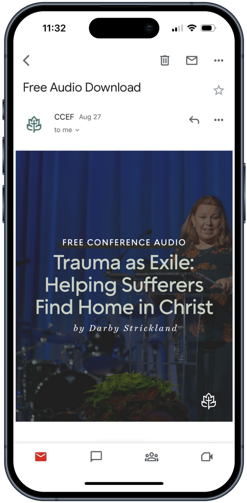
Sign up for our weekly email and receive access to a conference talk by Darby Strickland on helping trauma sufferers find home in Christ.
Loading form...