Christian Counseling & Educational Foundation
1803 East Willow Grove Avenue
Glenside, PA 19038

David Gunner GundersenLauren WhitmanTodd Stryd
November 16, 2026
The holidays can be a season of joy, anticipation, and meaningful traditions, but they can also bring family tension, unmet expectations, grief, and complicated relationships to the surface. As we gather with family, we may find ourselves slipping into old patterns, navigating unfamiliar family dynamics, or grieving relationships that aren't what we wish they were.
In this episode, Gunner Gundersen is joined by Lauren Whitman and Todd Stryd to consider how we can prepare our hearts for the holidays with biblical wisdom and practical intentionality. They discuss how to recognize our hopes and expectations, consider the experiences of other family members, and prepare for difficult interactions. They also offer encouragement for those facing loss or unresolved family tensions, along with practical questions to help us reflect, pray, and consider how we want to respond. And when we inevitably fall short in loving our families well, they remind us of the freedom of confessing our sin, seeking forgiveness, and pursuing repair. Whatever your family situation looks like this year, you can enter the holidays knowing that God sees your struggles, offers his presence, and gives grace to help you walk faithfully.
Additional Resources:
- A Loved One Consistently Shames Me | Ask the Counselor video by Lauren Whitman
- Helping Your Family Grieve | mini book by Darby Strickland
- He Came to Earth . . . He Came to Us | blog post by Lauren Whitman
00:00 Preparing Your Heart for the Holidays
04:01 The Joy and Complexity of the Holiday Season
05:24 When Hopes and Hurts Collide
08:38 Slipping into Old Family Patterns
11:19 Rethinking Expectations and Considering Others
13:19 Communicating Hopes and Expectations
17:23 When Family Relationships Are Broken or Unchanging
20:02 Trusting God Without Trying to Fix Everything
21:23 Questions to Help You Prepare Your Heart
24:55 Supporting One Another Before, During, and After the Holidays
28:25 Simple Ways to Prepare for Family Gatherings
32:16 When You Fail to Love Your Family Well
35:55 A Prayer for the Holidays
Hello friends, and welcome to our CCEF podcast, Where Life and Scripture Meet. My name is Gunner Gunderson and I get to serve as the Dean of Faculty here. As you know, around the world, people are facing fear and grief and broken relationships and all forms of suffering. There are different cultures, there are different circumstances, but there's the same deep need for the hope of Christ.
And here at CCEF, we believe that God's Word speaks into the struggles of everyday life no matter where we live. And it's through your generosity that our biblical counseling, resources and training are reaching people across the globe. There's a beautiful array of brothers and sisters who are being equipped to care for others with Christ's wisdom and compassion and, friends, this need for hope truly does extend as far as the curse is found, and so does the reach of your generosity.
And so would you consider partnering with us to bring biblical hope to hurting people around the world? We would love it if you would give today at ccef.org/donate. That's ccef.org/donate. I'm honored today to welcome to the podcast two of my colleagues, Lauren Whitman and Todd Stryd. Hey, Lauren. Welcome.
Hi, Gunner.
Hey, Todd. Welcome.
Hey, Gunner. Glad to be here.
Thanks so much for being here today. Well, our topic today is something that's timely, it is relevant, and we pray it's helpful for our listeners. It’s “Preparing Your Heart for the Holidays in Light of Family Tension and Expectations.” Obviously, Thanksgiving and Christmas are around the corner for our American listeners. And so with that in mind, can we just start here? What is your favorite holiday on the calendar?
For me, it is Christmas. And it's taking me . . . and it's taking everything within me to not listen to Christmas music right now. I'm trying to wait until the first day of November, and I already have a song that I'm just yearning to play, and it's for some reason this year it's going to be Dean Martin's “A Marshmallow World.”
I haven't heard that one.
I love it, Todd. So you've decided already that that's the first song that you'll listen to, do you? Is that, is that what you're saying?
Yeah. It's just . . . it's going to be my theme song. I think it's . . . it's struck me last year and I haven't, I don't, I haven't had enough of it. So it's going to be my thing. My Christmas theme song.
That's where you're going to start November 1.
That's right.
I love it. So there's no pre-Thanksgiving or post-Thanksgiving start debate for Todd. It's just November 1.
Yeah, it feels right.
Does that include decorating on November 1? Do you start decorating for Christmas as well?
I'm wondering the same thing.
Yeah, if my wife would let me, but that . . . I don't have as much control over that as I do my music.
Lauren
Okay.
How about you, Lauren?
Well, I don't start decorating till after Thanksgiving, but that's not your question. I'm with Todd's wife on that one. Yeah. Christmas as well. Although, I’ll add, it's the combination for me of advent season and then Christmas. I really have just benefited so much, you know, in, in my adult life of just entering into that season of advent where it's marked by: we're longing for something and, and we're waiting for something that in the midst of just this broken world and just really trying to experience that and remember the truth of that.
Then leading up to just the celebration of God coming to earth, and that God has responded to his people's longings. So yeah, it's that combination of Advent and Christmas and the different emotional experiences that each brings.
Well, we are three for three because I would totally resonate with what you guys have both shared. And I think that sense of advent, Lauren has been really encouraging and uplifting to me too, especially in recent years. I just love reflecting on the incarnation, and I think each year it feels like my soul needs it. And obviously there's a sense of the world needs this child, the world needs this man, this God-man to come and to come again.
And so I feel the same way. I think as I was reflecting on this, I also thought a couple of things I really enjoy is this sense of just light in the midst of darkness, with days growing shorter, more darkness, and yet these just constellations of light all around, through decorations and then warmth in the midst of cold is another thing that I really enjoyed.
My wife will joke about how often I end up turning on this gas heater. I had a wood burning stove when I was growing up as a boy, and I tried to approximate that with our little gas fireplace, but I just love having that fire on in the midst of the cold weather coming. So wonderful holidays are coming up; at the same time, and this is why we're here for our conversation today, what is it about family and holidays that can also involve just such emotion, tension, stress, complexity? Almost regardless of the quality or the closeness of our families. What are some of the factors here?
Gunner, I thought about the question, and the image that came to mind is just that both our hopes and our hurts are really colliding in this season. You get this in intense time with family and friends, but it's also condensed. So there's a lot of nostalgia. There's a lot of traditions and excitement, ramped up energy, and then that collides with conflict. And there's the hurts of, let's say, divorce or deaths in the family and maybe the, the childhood home is no longer there. So it's just there hurts and loss at the same time as it's condensed into this intense time with tradition, longing, nostalgia.
I think additional factors of that intensity is that you're usually out of our routines, you know, during the holidays, and that in itself can be hard. And I've realized that more and more, you know, with having kids, how challenging it becomes to be out of routines or potentially out of our own spaces. And that also is challenging. The things that are familiar, comfortable to us, creates new temptations, perhaps, or just feelings of discomfort.
And when we're in, you know, close quarters with, with family members we’re being witnessed in a way that we're not usually right. Our marriage, our parenting, how we're doing with our communication in our marriage or in our parenting, for example. Those others have eyes on that and that can feel really vulnerable and stressful, wondering, “What are they thinking about how I'm doing, you know, as a parent, or are they judging me?”
That also increases a sense of stress during the holidays, being so up close and personal with our relationships in ways that we're usually not. I also thought of how a lot of times as Christians, we are growing and God is faithful to be growing us. But then when we get around our family of origin, it can almost feel like there's a regression in our growth.
We are back in proximity to people that we've known our whole lives, and there are very established patterns of relating and ways of communicating. And suddenly the growth that we thought we had kind of acquired for ourselves feels not as possible out of reach, even. And that can be just really disorienting and confusing of, “I thought I grew in this, but here I am, and I'm finding it really hard to practice this aspect of my faith that in other relationships or in other contexts, has become part of how I practice my faith.” So I think that also can be a really disorienting experience when we're home for the holidays with with our families.
So I really resonate, Lauren, with the idea of regressing back to kind of a future, a past stage of life and some of the temptations, the tendencies, the patterns that are there. I can picture myself at 14, sitting at a particular spot at our dinner table in Oklahoma, growing up in some of the attitudes and mindsets and perspectives and emotions that I would have at that place at the dinner table.
And remember going back ten, 20 years later and sitting in that same spot and beginning to feel those same things and realizing that my heart had developed patterns that were very easy to slip back into, and I needed to be attentive to those things and aware of some of the temptations I might face in that, and try to be prepared for those.
Yeah, I found it really personally challenging. And in my marriage and family culture, we practice forgiveness and then going, you know, into a family setting, a larger extended family setting, just realizing this is not part of that culture, and I am finding it so hard to practice it. And it was really an intense experience. I was surprised and humbled by how much I struggled to practice something that, again, is a part of my family culture, but not a part of that culture with the extended family. So it was quite a trial.
I appreciate how we're highlighting that. It's not just that individual people are meeting and interacting, but that there are dynamics of past and present. There are different family group cultures that are . . . that are intermixing. There are, as you said Todd at the outset, these hopes and ideals that we have for our family relationships. And yet, then there's the the real that is colliding with the ideal.
There are the hurts that are colliding with the hopes and that we are in that kind of, that kind of environment, that kind of, really challenging swirl of things sometimes that are going on, not just one person and one person interacting. What are some ways that we could think just biblically and practically about family expectations around the holidays?
And there are obviously expectations that others may have of us, but we also bring our own expectations into our family gatherings and our times together around the holidays as well. So how can we think biblically and practically about this issue of expectations with family?
One thing I love about where Scripture guides us is that it, it helps us to have perspective. It opens windows and doors for us to think differently beyond what we might naturally think. And so, just think about Philippians 2, which is, “Consider the interests of others.” And the perspective that I think that brings is, the other family members, the other people around us.
They're not inherently different than us. They're going to have expectations and longings and hurts and irritations. Just as Lauren said, their family systems are going to be upended as they gather with me and my family. So just as recognition that they are encountering the exact same thing I am, but just from a different angle.
And so what Philippians 2 just helps me to see, us to see, is that in Christ, we can actually step back and consider that we can have eyes to potentially see and have compassion, and then, and then, potentially love them and accommodate them in light of getting inside their minds, their skin, their family dynamics. It's just a way of helping us have perspective of how to care for them.
I think another aspect that would be helpful is to consider your own expectations and put words to them. Sometimes they are not quite yet at our own level of awareness, and it can just be helpful to name those for ourselves. What . . . as I'm going into this time, what are my expectations? Another way to get at that would be to ask yourself, “What are my hopes? What are my desires for this time? And how have those perhaps formed into expectations?”
And then as a way to consider others to, just in the midst of realizing and recognizing your own hopes and expectations, to not let those become demands that you're making of your family members, that it's good to have desires. It's good to have good desires. And at the holidays we desire, usually for, you know, that time to bring about, you know, closeness and deepen our relationships. And those are our good things. But how are we going about fulfilling those desires? And are we just keeping our hearts in check? So again, that those expectations for closeness or desire for closeness don't become demands that we're making of people, especially if they're not communicated expectations, and that that is another aspect that I think we'll get into further.
But, you know, how are we communicating what we're hoping for this time and are people on the same page and, and would it be helpful to communicate so we can get on the same page about what people are hoping and longing and desiring for this time to look like as much as possible? If those kinds of conversations can happen, it can be really helpful so that expectations can perhaps be met or clarified and agreed upon.
That's very helpful. Lauren. I think of the difference between a family that really likes to have a plan and a family that is really spontaneous, and those families getting together, and there's going to be different expectations and experiences there, or division of labor around the different things that happen, like meals and other things. How do we think about who's doing what and if that's a constant source of uncertainty or frustration or unmet expectations?
How do we think about those kinds of things? Or how certain traditions are going to go with different individuals or families that have expectations and experiences there? I do think that it can be helpful for us to think about “What’s some pre-communication?” As you mentioned, it could be helpful upfront so that we're not leaving everything implicit and then just stepping into it and reacting, but that we're being more proactive.
And if we can, if the relationship is in a place where we can have that kind of conversation in advance, I think that can go a long way. I know I've experienced some loss in some extended family relationships in recent years, and I've realized that my own role feels like it has changed and more, for all I know, it has.
But I'm getting used to that. And I understand other people are as well, and have realized there can be places where some communication in advance might clarify what is otherwise confusing, and bring some light to something that has become murky because of losses and shifts that have happened that are not only griefs to bear, but also responsibilities that have changed, that different ones of us are now taking on or need to adjust to.
I really like that. And the name of this podcast, right, is “Preparing for the Holidays.” And so I think one thing, one takeaway so far is one way to consider how to prepare is: are there any conversations that it would be helpful to have with who, about what, leading up to the time? So that is one practical takeaway already.
I love that we're we could probably camp out on this question for a while, but, what we're building on is that the Christian faith is, a hallmark is, that we believe we have a very active inner world. And so we can reflect, and we can anticipate, and we can consider these things. And whether it's considering our own hearts or the needs of others, just it allows us to consider God's thoughts after him.
What would you say to the many people who are in family situations that are not only hard, not only tense, but maybe irreconcilable or unchanging? Or at least there's no prospect for them to change in the near future that someone can foresee? So, for example, a loved one has died, a divorce has taken place, maybe a messy blended family situation, or adult children that are no longer in contact with their parents.
What would you say to people in family situations like these that seem to be irreconcilable and changing, at least for the time being?
The first thing I'd say is, “I'm so sorry.” That sounds painful and it's the unknown, you know? Will they be reconciled? Will they change? And that is just a painful place to be. So I'm so sorry if that is your situation as you move into the holidays, I would commend you to take time to attend to just the grief of where things are today, to take time with the Lord to lament where the relationships are, and to also take time and make room to enter into the joy and the rhythm of the holidays, to have both experiences.
The grief and the lament is called for, and also, you know, the thanksgiving is called for. Take time to enter into the practices of thanking God for the gifts and blessings of your life. And at Christmastime to enter into the joy of God sent His Son into the world. So just allowing yourself the space to enter into both realities, the spiritual realities and the relational realities.
Yeah, that's well said, Lauren. Allowing the space to enter in those spiritual realities. One of those, or two of those, are spiritual realities. One is that God knows. He knows the pain, the loss, the conflict, the challenge, and he knows it and he understands it. He recognizes what you're enduring, what you're going through, what is hard.
And that other spiritual reality that Lauren is highlighting: the practices of the season . . . is that there's also hope. So he knows, he understands, but he also provides hope, hope that he will be present and hope that someday all these things will be made right again.
I'm reminded to you in these situations that the Lord's calling in my life, in our lives, is to trust him and to do our best with his wisdom in the situation, but not necessarily to resolve the unresolvable, or to reconcile the unreconciled. I know for me, it can be tempting when I'm facing a really challenging family situation, to also feel like it is completely my responsibility to repair and fix that situation, even when if I'm stepping back and being objective, I know that it is not fully in my control and I think that's significant for me to recognize, to be able to trust the Lord and then to seek to walk by the Spirit as best I can in this situation, but not over-define what faithfulness looks like. By thinking that faithfulness must mean some form of full resolution.
What are some questions that you might ask someone to help them get clarity about their family dynamic, their role, what they're facing, how they can respond? What would be some questions you might want to ask someone to help them move forward with a greater sense of perspective or clarity about their situation as they head toward the holidays?
Yeah, there are so many that come to mind. And as we, you know, again, we're building on the fact that there is value in anticipating and reflecting and doing a bunch of pre-soul work before we encounter these situations. So asking questions like, “What are you feeling and what happens in you as these holidays approach?”
Can you name the emotion? Can you paint a picture of the scenario that you're most concerned about or dreading? And then maybe one more: what are some places, or what some things that God says about who he is or who he promises to be or to give you that that can then be inserted into those fears, concerns, anxieties, those worst case scenarios: Who does God promise to be? And claiming those aspects of God's love and care? So both in anticipation, look at what are you anxious about? What are you worried about? What could go wrong? But then an anticipatory look at how God promises to actually also be present in those situations offering himself.
I agree, there's so many questions that could be helpful in preparing to see your family at the holidays. Another one that I might explore is to think about previous holidays, previous times together with your family, and to recall what was hard about it? What was one particular hard interaction that you had and how did that go?
What did that look like in terms of how you communicated, how you responded? And then from there, as Todd said, to be anticipatory, if this were to happen again, how would you like to respond? Would you do anything differently to just name that? How would you like to handle this if, if a similar occasion arises. And so that preparation, as well can be, can be helpful to look back in order to sketch a new way forward that you'd like to take and then you can pray, “God, help me to, to respond in this kind of way. This would be my desire. This would be my heart in this kind of scenario: that I would respond in this kind of way, would you help me?” So to name that and to ask for his help with that. Another anticipatory question would be if you were to say, “At the end of this time with your family that it went well, it was a success, then what would have had to happen during that time?”
What to you is success? And then to ask yourself, well, as far as it depends on me, how can I play a role in bringing about that outcome? It doesn't all depend on you, right? You're not responsible for all of it. You're only responsible for yourself. But how would you like to conduct yourself towards that end of you being able to say, “This went well. I'm thankful. This was a good time.” So again, naming that kind of outcome and then praying and asking for God's help to work towards it.
Such good insights from both of you. Thank you so much. And your comments are reminding me: I think the holidays are such a good opportunity for us to love and support one another well in Christian community and I think with the holidays there's a before, a during, and an after. And I think there's ways that we as brothers and sisters in Christ can love and support one another well in the before, which we're talking about; during, as we consider how we might touch base and get an update: “How can I be praying?”; And then, after, how we can follow up and support if things were difficult and went poorly, or rejoice when we see specific ways that God supplied that grace that was needed at a particular time (like Hebrews 4 talks about: “mercy and grace to help in time of need.” And so just a great reminder to me that this is one of those very concentrated experiences that as we lovingly support one another, we get deeper access to each other's hearts and lives and what matters most to us. And we can walk with each other through a micro-chapter that is, that we might go together, go through together, as families.
One more encouragement is that this inventory, anticipatory work we're talking about, it really is hard work. We . . . it's going to be easy to find a reason to not do it, to put it off, to ignore the coming holiday gathering until it's 12 hours away. But, there is so much fruit that can be born from doing that hard, embracing, facing work that we're identifying, asking some of these questions, contemplating the before, during, after scenarios, and leaning into God's promises. It's easy to avoid, but it's very fruitful to engage.
Yeah. Along those lines, Todd, I was reflecting on Psalm 90:12 today as I was preparing for this conversation, and I never applied it to this context, but I was starting to where that verse says, you know, “Teach us to number our days, that we may get a heart of wisdom.” And that idea of numbering our days speaks to the fact that, you know, time is limited and life is short, and we don't know what future opportunities we may have.
And all that's true of our time with family, right? It's limited: this holiday experience. And we don't know what next year will look like or who will be there. And so God, teach us to number our days so that we may gain a heart of wisdom. And I think, as you're saying, this work that we're encouraging our listeners toward is unto that heart of wisdom. So I, I am thankful for it. Personally, I have never, you know, taken time to write out, you know, the answers to my, you know, these questions that we're posing. But this year, I think I will because I want to be wise and I want to use the time well. And that doesn't just happen. And I can lean into the hardness of that so that I can, again, at the end of the time, say that as far as it depended on me, I, I tried to go into this well; I, I sought to be faithful.
As we think about this and move toward our conclusion, what are some simple and practical ways that we can prepare for the holidays with our family, regardless of our situation? We've talked a little bit about what some questions might be, that we might ask someone to help them discern their situation. Their heart as they prepare. Are there other practical ways that we might be able to prepare for the holidays, regardless of what our situation may be?
And I'll just start out here with one thought: I remember a number of years back, recognizing some of the patterns, temptations that I had when I would be at home with my in-laws, when I was particularly newly married, and in that maybe first decade or so after. And I realized that it was helpful for me to identify 2 or 3 specific words that could be orienting for me and reorienting for me in specific moments.
And I realized that at that time, I was in later stages of seminary. One of the things I wanted was discipline. There were some things that I needed to get done, even over a holiday break, that I wanted to get done. Another word that I often used was engagement. Part of my temptation at that time was to disengage when I felt like things were a little tense or I didn't know my role, etc., and then a third word that I sometimes used was affection. Wanting to express affection and cultivate affection for this newfound family that God had given to me. And I remember that having those specific words in mind enabled me to have a clarity in various moments when I started to feel disoriented or frustrated or uncertain about how to engage or what my place was. And I could pray over those words, and they gave me some direction in those moments. That's one practical thing that I started to find helpful.
What I really love about that, Gunner, is it's simple and memorable because at the holidays there's a lot going on. It can be chaotic, again, many people in small spaces. And so to be realistic about what you can accomplish, which will probably be simple. And so what is a simple way you want to pray? What is one spiritual fruit that you'd really like to focus on, to ask God to cultivate in you during this time with these particular family members?
Building on that, what is one phrase from a Bible verse that could be instructive to your heart? That, again, is simple and memorable and nudges you in that direction of fruitfulness and faithfulness during your time with your family.
And I think this goes along with both of what you guys are highlighting. And that is just that, just maybe an association in my mind is potentially to, as we're doing our anticipatory reflection to come up with a person and then an associated posture towards that person. So there may be a hard, a harder person that you're going to be encountering.
And maybe you find that it's easy to take things personally when you're around them. So you've got this person on your mind, but also maybe you, you find a posture, like “Love covers over a multitude of sins.” So and it could be the opposite: it could be someone that you know, can get easily left out there, quieter, maybe they're younger. And so you just find that in your reflection, in your prayer, in your consideration that God puts a person on your mind and your heart. And he also, gives you an associated posture of love or care, or ministry towards them.
And one final question that comes to mind, because knowing who we all are as people and knowing some of the temptations that we face and in family situations over the holiday, some of the intensity of those temptations, it is inevitable that at various points along the way, we will fail to love our families as we're called to, or respond in ways that are wise or are kind.
What do we do when we fail over the holidays and we mistreat someone, we respond in ways that we know are less than what God calls us to, we overstep in certain ways, or we withdraw and we simply neglect? And there's so many different ways that can happen, but knowing that we are sinful people and in various ways will stumble over the years in these interactions. What would we say to people in advance about what you do when you fail with your family?
It can sound simplistic, but I do think leaning into the reality that we can in Christ, in his forgiveness, in his love and care for us, in his constant stability, that he does empower us to do that hard thing of owning it in reality to ourselves before God. Okay, that did not look right. I failed, I slandered, I, I was sharp. So we can own it both to ourselves and before God, and as we're talking about it, naming, embracing it, but also then saying if there is a way forward to acknowledge it before that person, you know, these are likely scenarios and, family relationships where we will encounter them again. And it is a good thing to humble ourselves before the Lord and to find a way of seeking repair.
As hard as that is, even, I, I think if we can anticipate the fact that we will probably fail, we will hurt someone, we will say something inappropriate that 13-year-old Todd will come out, or that 14-year-old Gunner and that, that we can even anticipate ahead of time that we will need to ask for forgiveness and own our sin, that that can set us up.
Yeah, we're talking about expectations, right. And we're recognizing that we should expect as broken, sinful people that we will fail and there will be misunderstandings. And so we should also expect that we will need to do that follow up repair work that Todd is describing. And so just commending that to our listeners and to us, to all of us, we all fail to love in instances.
And we want to be ready as God's people, to demonstrate his humility, and to demonstrate what it is when we have the Spirit, which is we, we can humble ourselves. Now we can confess because we believe, because our faith tells us that we have a God who stands ready to forgive. And so we act on that, and we demonstrate that there is great freedom that comes when we are living with the reality of, of who we are in Christ.
Well, what a beautiful place to land. And as you mentioned, Lauren, having the power of the Spirit. I'd love to close with a prayer for ourselves and for all who are listening from Galatians 5:22-25 about the Fruit of the Spirit. So allow this to be a holiday prayer for all of us. And thank you again for the conversation.
“But the fruit of the spirit is love, joy, peace, patience, kindness, goodness, faithfulness, gentleness, self-control. Against such things there is no law. If we live by the Spirit, let us also keep in step with the Spirit.”

Dean of Faculty
Gunner is the Dean of Faculty at CCEF, where he has served since 2024. He holds a PhD in biblical theology from the Southern Baptist Theological Seminary and a master of theology and master of divinity from the Master’s Seminary. Prior to joining CCEF, Gunner served as a lead pastor for seven years, after working for fifteen years in Christian higher education as a resident director, director of student life, associate dean of men, and biblical counseling professor. Gunner has a passion for helping believers live consciously in the story Scripture tells, equipping the local church for interpersonal ministry, strengthening pastors, and biblical preaching and teaching. He has published the Psalms notes for The Grace and Truth Study Bible (Zondervan, 2021), What If I Don’t Feel Like Going to Church? (Crossway, 2020), and numerous essays and articles on the Psalms and adoption.
David Gunner Gundersen's Resources
Faculty
Lauren is a faculty member and counselor at CCEF, where she has served since 2010. She is a licensed professional counselor and holds a master of arts in counseling from Westminster Theological Seminary and a certificate in advanced professional counseling from Missio Seminary. Lauren also serves as the developmental editor for the Journal of Biblical Counseling. Through her work with the Journal, she brings experience and skill for developing authors and their writing. Lauren has published multiple books, including A Painful Past devotional (P&R Publishing, 2020) and When Parents Feel Like Failures (New Growth Press, 2024). Lauren is married with two children. She enjoys exploring Pennsylvania’s creeks with her kids and exploring Philadelphia's restaurant scene with her husband.
Lauren Whitman's Resources
Faculty
Todd is a faculty member and the counseling coordinator at CCEF, where he has served since 2005. He holds a doctor of psychology from Immaculata University and a master of divinity from Westminster Theological Seminary. He has experience as a hospital chaplain, crisis worker, and university counselor. He has written a minibook entitled Schizophrenia: A Compassionate Approach.
Todd Stryd's Resources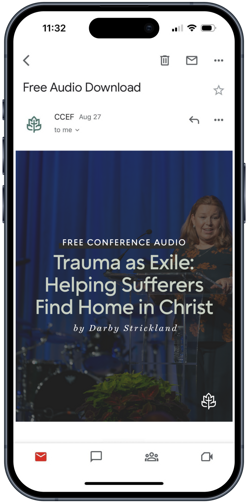
Sign up for our weekly email and receive access to a conference talk by Darby Strickland on helping trauma sufferers find home in Christ.
Loading form...