Christian Counseling & Educational Foundation
1803 East Willow Grove Avenue
Glenside, PA 19038

Aaron SironiDavid Gunner GundersenEd Welch
October 5, 2026
Comparison and envy are such ordinary parts of human experience that we often barely notice them. But what do they reveal about our hearts, and how do they affect our relationships with God and others? In this episode, Gunner Gundersen is joined by Ed Welch and Aaron Sironi to explore how envy takes root in the things we value, from recognition and influence to relationships and abilities. They consider how social media can fuel comparison, how envy undermines love and contentment, and how it can expose our doubts about God's generosity.
Rather than simply telling ourselves to stop comparing, we need something more profound: a renewed vision of Christ and all we have received in him. Through Scripture, gratitude, and a growing appreciation of God's character, we can learn to loosen the grip of envy, celebrate the gifts of others, and find our worth in Christ.
Mentioned in this episode: There's still time to register for our national conference next weekend! Learn more at ccef.org/2026.
00:00 Introduction
01:09 What Are Comparison and Envy?
04:54 What Envy Reveals About Our Hearts
05:24 Everyday Examples of Comparison and Envy
09:37 Social Media and the Temptation to Compare
12:39 The Relational and Spiritual Effects of Envy
16:40 Why We Need More Than Willpower to Overcome Envy
17:46 Finding Our Confidence and Worth in Christ
22:07 Is What God Has Given Us Too Small?
25:29 Learning to Be Faithful with What God Has Given Us
29:18 The Freedom of Saying, "He Must Increase, but I Must Decrease"
31:32 Practicing Gratitude and Celebrating God's Generosity
35:01 Moving from Thankfulness to Knowing God
38:02 Closing Prayer
Hello and welcome to our CCEF podcast, “Where Life and Scripture Meet.” My name is Gunner Gundersen and we are excited that fall has arrived. We are just a week and a half away from our national conference on a theme called “Fully Human: Life as God Designed.” We are meeting together in Virginia Beach, but if you can't make it to Virginia Beach, we want to invite you to join us virtually.
And if you do, you'll get access to the general sessions, live streams, and all breakout session recordings. You'll also get exclusive access to virtual stage interviews with our speakers after every general session. We're very excited to welcome guest speaker Nancy Guthrie, as well as our worship leader, Sandra McCracken. You can learn more about the conference and register at ccef.org/2026.
Well, I'm excited to be joined today by Dr. Ed Welch and Aaron Sironi, faculty members and colleagues here at CCEF. Welcome, Aaron.
Thank you, Gunner.
Hey, Ed.
Gunner, hello.
Guys, thank you so much for joining us today, and our topic today is one that I think will be relevant for all three of us, relevant for every person who is listening, relevant across time. Our topic today is comparison and envy. Comparison and envy. So can we just kick it off this way? What are we talking about when we talk about the topic of comparison and envy? What is it and how does it work?
Gunner, one of the benefits of being invited to do a podcast is you have to think about it a little bit more than you normally would. And that has been invaluable, because my first thought is that comparisons are just a human instinct. They’re what we all do. And since they're like an instinct, we don't even think about them.
They are bothersome instinct, of course, but they are just so profoundly human in every person, in every culture, at all times. So, so with that in mind, the idea of pulling this out and identifying it is really important. So yeah, I'll start. Okay. It's on the “greed” end of the spectrum. We know that it's, “I want, I want something.”
So I move on to that, into the spectrum and I think of, “Okay, I go into a music store and I want most everything that's in there.” Okay. But that doesn't quite get to envy. It's getting close. But there's something about envy that is more personal. It's “I want what that other person has… the other person has something that is admirable, that receives some recognition from other people, and I don't. That's what I want.” That's for me that's sort of situated us in this. And once I've been situated there, all of a sudden I can see it all over the place.
That's a great place to start, Ed. You know, what I would add to that it's not only recognition or attention, “glory,” we would say, you know, in a spiritual category, it's also whatever I value, whatever is important to me in my heart, what I treasure…if someone else has more of that, in my opinion, and they're around me, that's where my heart, that's where my envy, is stirred up is, you know, “I want that, it's important to me and this person has it,” and that's like where you start with greed. If it's something I don't value, you know, if I'm driving a, you know, a 1998 Chevy Chevette. Actually, I had an ‘83, and I love it…
People weren’t driving them by ’98…
’83 is what I was driving. Okay, so I was driving that thing, you know? And I'm tickled pink. It was given to me by my great aunt, and I didn't pay a single penny for it. And I felt like the luckiest man around, and I didn't even deserve that. And so I'm driving around, you know, and I'm seeing sports cars and “whatever…I have a car and I'm not on my bike right now.”
There's just something about envy that…it's discriminating. It just it doesn't want everything great; you don't care about a Maserati. It's like a different category. Somehow, somehow it has to come a little bit closer, like you're saying, to those things that are especially valuable to us. That's when it catches us.
That's right. So, each of us, it could be a little different. Now. There's not like 50 different things that we’re envious about. But there's a few core things, right? And they are different for each person.
So there's a sense in which comparison and envy are revealers of what our heart loves and longs for, as well as revealers of what we might not care about so much. And can we talk a little bit about maybe, maybe in light of that, what are some arenas of life, like some life categories, where we might easily compare ourselves with others, areas of life where we might struggle with envy or different kinds of people may struggle with envy?
Okay, you're making it more personal now. Before that, it might be helpful for me to say, “Yeah, this reveals my heart,” but this is huge. This is huge. There are two ways. There are two kingdoms in the world, and one kingdom is the kingdom of comparisons and glory and reputation and name and value because somehow we have risen above some others. That is, that is an essence of the kingdom that is against Christ. The Kingdom of Christ is one where that has been broken down and we have received honor in Jesus and we are pleased to give honor to other people. So this is huge. It's everywhere. And it gets to really the very heart of Scripture.
It's not just something we wrestle with every once in a while. All right. I'll let me think personally…two things that come to mind, one early and one late: the one early is my wife and I visited a new church, were invited over to somebody's house for dinner for lunch after church. And and all of a sudden I was feeling uncomfortable because this guy, I don't think about guys as being real good looking necessarily, but he was really good looking, and he was certainly better looking than me.
And I hadn't been married that long and yeah, I already felt like I was down a rung. And then here he made the entire lunch and I've never made lunch for my wife. And then he cleaned up all the dishes and, and at that particular moment I was thinking, I don't know if I can be friends with this person.
You see, envy, there's a personalness to it, and it clearly disrupts relationships. So that's one of the early ones that I think of. A later one: I was at a conference recently and there was another person speaking, a friend of mine, and he said something and people laughed. They just laughed riotously. And I though, “People didn't laugh that loud when I was speaking.”
And then he finished speaking and he got this applause. And I am pretty sure that his applause lasted more than my own. And, so what this podcast is doing is it's reminding me that sort of passing human instinct. I need to pause on that and say what is going on in my heart so I can give you ten others. But there that's a one in the distant past and one in the recent, in the very present.
I can, you know, I can do this in parenting where we have five children. And it's interesting at times to see which parent one of the children goes to for advice or to share something. And, and oftentimes my kids, especially my older kids, might go to my wife. My boys will go and share something that's hard or something they're struggling with. And on one hand, I am so thankful that they can do that and that they feel they have that kind of relationship with their mom. But if I'm really honest, well, I mean, “You can talk to me, like, you know?” Like, well, “I care, and don’t I have good things to say? I'm not going to jump all over you,” like, you know?
So I start to feel a little bit envious as a father, feeling like, you know, “Well, why don't you come to me? Why do you go to mom? Always? And somebody asked, actually, my son recently, “Who do you go to when you're scared? And who do you go to when you need help? And, And which parent?”
And his answer was, “When I'm scared, I go to dad. When I need help, I go to mom. And I was like, “Okay, I can handle that. At least I got 50% of the airtime there. So you can see how it works, right? Even as a parent, even as my family.
Man. Yeah. Gunner, could you say some more things? We're talking about personal illustrations and we can pick out from our own lives. You are cooler than us in many regards. And here's…but this is interesting. You are better at this than me. But I'm glad you're better. So there's sometimes comparisons…they don't bother us. We're really glad; we admire them.
You know what's going on in social media in a way that I don't. Well, you're reflecting on comparisons that are still personal, we're talking about actual people we know, and we're comparing them, ourselves, to people that we know. Social media: you don't always know those people. What are your reflections on how this religion of comparisons enters into social media?
I think it's always dangerous to say that something is unprecedented, since Solomon makes clear that there's nothing new under the sun, but I do think we could probably safely say that we have unprecedented access to snippets of other people's lives today, and we just have an overabundance of access to what's going on with other people, or at least what they're sharing with us.
And I think that there's just a real temptation to comparison, to envy, to self-pity. When we are accessing social media, especially when we're using it thoughtlessly, which is is really tempting, I think that it seems that the algorithms behind these things draw out, on the one hand, outrage, which is showing us something negative that seems worthy of condemnation, or anger, that keeps us scrolling or clicking or going deeper.
And then on the other side is things to envy. So these are maybe projected as positive things. They might be wicked things, but just projected as, “Hey, these are things people enjoy. These are things that are successful. These are things that make you desirable.” And those really draw out envy. And so there's a sense in which social media can really appeal to both anger and hunger, if you will, on the negative side, and on this seemingly positive side of just longing for something different than what I have, they call it upward comparison
Sometimes we see something and it just seems to be above us, farther than us, more influential, more desirous, whatever it might be. And I think one thing that stands out is they talk about there is both active social media use and passive social media use. And I think the reality is even passive use where I'm just looking, scrolling, seeing, viewing, it's never passive actually, because, you know, it's our fourth distinctive here that says, “Our hearts are active. And I can certainly see that play out in my own life as I just see the abundance of things that are laid out before me on social media and online that we have just seemingly unlimited access to.
Yeah, you’re causing me to think about the rise of depression among people in that social media group. And depression can have all kinds of different reasons. But one is it's envy that is given up. “I want what that person has and it is out of reach. And I will never, never have what that person has.”
Can we talk a little bit, Ed, because I think you're helpfully taking us down this road. Just some of the, the potential effects of comparison and envy, things that are on, on the back end, on the, on kind of the trailing edge of this, that at times could be helpful indicators or warning signs to…it's not to say that depression for example, is always due to envy, that's certainly not what we're saying. But that comparison and envy is going to lead places. It's going to have effects. What are some of the things that we might see in that regard?
I want to be aware of those smaller moments of envy. That's the one I was describing with the person who was speaking where it was somewhat fleeting. “Hey, they're laughing more, they're applauding a little bit longer,” but it just… it didn't stick that long. But I want to be aware. I want to have those kinds of windows to my heart to go back to the earlier story, when we know the person we envy, we know them face to face, there's…how do we maintain a relationship with that person? When they're… when… how do I say it?
Love in some ways is the opposite of all things that are disagreeable and and wrong in some way. When I can't love, when envy is always competing with love, how can I have a relationship with that person? The only way I can have a relationship is to somehow see things that are weak in them, and perhaps even subtly advertise those to others.
You see, what am I saying? I'm saying there is a subtlety to this because it's so normal. But what I'm saying is, when we know the person we're envious of, it breaks relationships. It moves people apart. Anything that moves people apart, we are highly, highly suspicious of it. What you were talking about a second ago with social media, we don't know those people. So we're not separating ourselves from a particular person. It's rendered in our hearts as anxiety, as dissatisfaction as this constant lack of contentment, as despair.
Yeah. And let me add to that. It is in addition, maybe even before it breaks relationships with other people, it is a breaking of a relationship with my Heavenly Father, my Creator. Right? Who, you know, from the time of Cain and Abel, to…you see it with Nathan's confrontation of David, where the Lord says, “You're despising me. I am the one.”
Like I love how Paul says in 1 Corinthians 4, “What do you have that you do not receive? If then you received it, how do you boast?” As if you didn't, like, the sense of, this reality, “I am your Father. I have given you certain things. I, in Christ and Ephesians have given certain gifts and abilities.”
And, when I start to feel envious, what my heart is doing is despising the Lord, right? In saying, “Lord, you didn't give me this, and I want more of that.” Right? There's a breach that we have in our relationship with the Lord. And instead of being grateful for this brother or sister and their “whatever” that I value, I turn against the Lord and hold him in contempt.
Aaron. What you're, where you’re leading me is exactly where I want to go. The nature of this. It's so common. We just, you know, it's the way life is. But the more we're talking, the more I find myself thinking, “Woe is me. Woe is me.” There is no way that I'm going to think myself out of this.
There's no way that I'm going to rebuke myself out of it. And all of a sudden, stop comparing myself, stop envying. There's something… and this is the way it should be…we can, we cannot. We cannot break out of sort of these old snares unless the Spirit does it. So you got me. You got me in the right place.
I see this as an instinct. And simply knowing the way out is not going to be enough. I need Jesus to do something much more profound. So good. You got me. You got me desperate. That's a good place to be. Spiritually desperate, I should say.
One of the ways, one of the verses that the Lord has used in my life here, was from Jeremiah 9, where he, God says, you know, “Let not the rich man boast of his riches, not the strong man boast of his strength or his power. Let not the wise man boast of his wisdom, but let he who, him who boast in this…” Right? In that word boast.
You've talked a lot about that, right? Where? What does that mean to boast? I don't think it just means boast in the singular sense that, you know, I'm puffing up my chest and I'm telling everybody how great I am. I think there's also it also carries an inner confidence and inner “What gives me worth? How do I stack up against others-type confidence,” right.
And what Jeremiah is saying, what the Lord is saying is, is that cannot be the way that I measure myself, that cannot be, you know, comparing to others, whether it's wealth, whether it's strength, whether it's wisdom, smarts, intelligence, success. He says, no, but let him who boasts, boast that he knows and understands me, right? That I'm a God, you know, steadfast love of justice and righteousness.
And that is what, so for me, like, it’s saying, “I'm doing it again. My heart is longing, craving, yearning to take confidence in something that's important to me. Father. Help me. May I glory in your steadfast love, that you know me, that my name is written in your book, that you have given me gifts, that you…” you know, right?
That I am yours, and that you are a God who is glorious. So that's one way where I'm trying to push back against a really dangerous and subtle sense of trying to take confidence, trying to have worth, feel worth based on comparisons.
You get me thinking about a few different things. One is, we're not going to find this particular challenge simply in the word comparison in a concordance. We'll find it everywhere. And one of them is the word honor. And that's what I was thinking, where we look for honor in ourselves, I, you know, we have been given this great honor in Christ, but we are looking for it in ourselves.
That's, you know, that's the heart of this. So that's one way you get me thinking. But, Aaron, what you did for me is I'm following you. My heart gets more hopeful because you're saying there's something more profound than these people who are better looking than us, or have more talents in those areas where we would like to have some of those towns, you know, some of that honor for ourselves.
When I look at other people, all I can do is say, “Woe is me,” because I don't have those, but I keep but the envy stays in my heart. What you're saying is, “All right. It has to be driven back to the person of Christ.” And then all of a sudden, there's a kind of freedom. All right, here's something I can be drawn to.
What does it mean to boast about Jesus? What does it mean to boast about him? To, this sounds like a horrible way to put, but it in my own heart,to make Jesus more important than myself?” What an indictment! But that is the turning point. When we get into this, we say, “Oh yeah, yeah, I'm worse than I think.”
And it is everywhere. And then we think, “How do I get out of it? Well, I have to be nicer to people. I have to be less envious.” And it doesn't get us anywhere. But when we come back to Christ and say, “Okay, he is the worthy one. Okay, now what? What does it mean to know him and honor him above all else, including myself?”
So. So I appreciate where you're taking us.Yeah, it's all of a sudden hope enters into this.
I've been doing some work in Numbers 16 recently on the story of Korah, who gives in to discontentment. And it's really striking after he comes and demands more, a higher position in the camp. There's a response that Moses gives him, and Moses asks him, to Korah, who was a Levite and had a substantial position within the camp already and a privilege of serving the Lord, Moses asks him, “Is it too small a thing for you that the God of Israel has separated you from the congregation of Israel to bring you near to himself, to do service and the tabernacle of the Lord, to stand before the congregation, to minister to them, and that he has brought you near him, and all your brothers, the sons of Levi with you. And would you seek the priesthood also?”
That phrase has just been ringing in my ears for a while now. “Is it too small a thing? Is it too small a thing?” And you guys are reminding me of, like, is it too small a thing that I've been justified and declared righteous by grace alone through faith? Is it too small a thing?
I've been adopted into God's family. Is it too small a thing? I've been given these spiritual siblings around me that I have the promises of God just. It's such a good reminder of how, for me, comparison and envy really amplifies the things that I think other people have that I may want, and so minimizes what I've already been given in Christ.
The journey from this, this pagan world of comparison to this world of Christ. It's a lifetime work. One of the things I appreciate about Scripture and you just identified it is, is, is the Lord will take us in these small steps. So in this case he just, he asks a question of us, this is too small a thing.
Is this too small a thing? I think the spiritual step for us is we can't just read it in the pages of Scripture. We have. We have to hear this: Is God posing this to our very souls? Is this too small? Is it? Is it too small? Okay, well, what have I done for you? Is that too small?
In some ways, we could stop right there. As long as that question would persist. But that's the problem. That question, which is a beautiful question. It has a short half-life and and by the time we’re done, all of a sudden we're out into the real world again, but isn't it so, so gracious and so gentle of the Lord in that particular situation, somebody wanting more.
And it was divisive even in Israel. It is my calling to you and is what I have given you. Is that too small? So that's all these little places the spirit comes in with beauty and gentleness and, and and invites us to. Well, no, please answer the question. It's not. It's not merely a rhetorical question. Answer it, please.
You know, because my mind goes to the story of David and King Saul, and when David is rising up in popularity and, yeah, there's notoriety within Israel and outside of Israel. And Paul is jealous, excuse me, Saul is jealous. He's envious of David's abilities, of his courage, of how their people are praising him, singing, you know, praises about him.
And I think, “What would it have looked like for King Saul to trust the Lord there in the midst of it?” It's an impossible question, but because he doesn't. But what would it look like for him to say, “You know what? David is going to take the throne someday, but that day isn't today, and I am the King of Israel. And how do I rule and lead, faithfully and with integrity, and serve my people and my God in this way?” The story would have been very, very different. He doesn't do that. But even then, you know, struggling with jealousy and envy in comparing himself to David, there was a way to be faithful, to humble himself and even knowing he's on a he's a lame duck, essentially.
But what can he do as a king? I'm thinking of that. You know, Gunner, as you're saying, like, what does gratitude look like? What is acknowledging what God has done, where he has placed me? Very simply, we are servants, and we're just called to be stewards of what God has entrusted to us. And what would that look like in any given situation that we find ourselves in, in struggling with, with others who may have more, more of what we desire?
Yeah, yeah. What you guys are doing, you're asking us, can we land on something that helps us to see this particular matter? Is it too small? Is it too small? Or looking at the story of Saul and David, which was the beginning of the tearing apart of the kingdom from Saul, and being given to David because of his own hubris and arrogance and desire for glory, you know, do I have a story like that that is arresting to me? I don't. I don't know if I do. So it's just very profitable to hear some of the stories that you guys are identifying. I probably go to Paul and go to…but Paul is so far ahead of me here. He doesn't reveal my own heart so much, but he feels something so much better.
And Aaron, like you're talking about boasting, what does it mean to boast in Christ? I always come up short when Paul talks about his resume, and he says, these are the dangers in my life when I can do comparisons and I come out better than other people, that is utterly deadly. It is. It is part of me being in this old kingdom of works, which is what everything else outside of Christ is.
And may it may it be like rubbish. So, that model is lovely to me. But frankly, sometimes it's so far ahead of me that I barely even know where to start. But it's certainly one place in Scripture that brings me up short. So I appreciate these illustrations.
One of the passages that consistently ministers to me, convicts me, challenges me, but also sets, an aspiration is, in John, when John the Baptist is told that there's disciples that are going over to Jesus and there's this increasing influence, and John is expected to be concerned about this and bothered by it.
And then you're going, and John is just astounding here. But go ahead.
It is. And you know, and he just says that he must increase and I must decrease.
Yeah. Yeah. That's impossible. That's crazy.
It's so interesting because it's also such an example. That statement itself of what Jesus talks about of the last shall be first and the humble exalted in that that statement that he makes has echoed down through the ages and continued to make an impact through Holy Scripture on us all. And it is just a remarkable statement.
And there’s none greater… and there’s none greater than John. Yeah.
There's so many features to it that are really beautiful. And I think, you know, when I think of, of the hymn “Come Thou Fount” there’s this line, you know, to “tune my heart to sing thy grace.” I think my, I think our hearts are that we would be tuned to the heart of John the Baptist there.
That we would have a similar heartbeat in place of the comparison and envy that can easily rise up in so many different arenas of life. As we've noted, it's, it's, there's we're all fluent in one sense in, in comparison and envy. And yet we all have our own little accent as well, the specific arenas of life where we may struggle.
And yet Scripture, as we've talked today, is so rich in helping us understand it. And as you've emphasized so helpfully, it is actually speaking directly to us, asking these questions not only to characters in Scripture, but the Spirit asks those questions to us and holds these examples before our very eyes so that we can see and be changed. So this.
This, this empire of works in comparison. How are we loosened from it? What we're expecting, given these illustrations, there are these accessible steps, ordinary steps available to us all. So, one of the things I'm thinking is, is simple. Thanks. At the end of the day, for what am I thankful to perhaps have two parts to it, one with my eyes open.
What are the events that have been a blessing to me? What are, where are ways I have seen Christ in others? And then with my eyes closed, where? What have I received in Jesus? And do I think that that's really, really big or small? So that's one just to be letting things in. Another is when I…
Before you go on to the second one, I think there's something really there at the heart of envy that, you know, people could hear like, “Oh, well, just give thanks, be grateful.” Right? And at the end of the day, just say, you know, “Count your blessings one by one.” But that is at the heart that strikes. That is the antidote to envy.
It is a genuine “Lord,” as you were saying, Gunner. It is a genuine “Lord. You have so richly blessed me in Christ Jesus.” And you know, my wife and I were up, well I was up, about 2:30 this morning, just agonizing and crying out to the Lord. And, you know, you're not supposed to stay in bed. So after about 20, 30 minutes of wrestling and in bed, I get up and I'm walking around, you know, in the living room trying to keep my wife asleep, you know, and I gave up at some point, and I came in and I just was talking to Kellie and woke her up, and she said, “Aaron, but how has God been gracious to you, to us? To us in our family?” And I said, “Well, Kellie, I found my wallet.” I lost my wallet for like three days. I couldn't find my wallet. And I'm, you know, I'm going to the gym, talking to people, the front desk. I'm just like, Lord, I'm praying even as I'm in counseling, you know, I'm like, hey, people like the couple, I was counseling, “Can you pray for me? I have no wallet and I have to travel in a few weeks here.” Anyway, I look in the back seat of my car and it's on the floor and I need to see. I don't even know how it got there. But it was there, and I just said Kellie, and she laughed, you know, like 3:30 in the morning.
I'm so thankful she laughed and didn't whack me or something, elbowing in the head. But she said, “You know, that's something, right?” And that's not I'm not trying to be trite here or, you know, like frivolous. No, thank you, Lord. Like, you know, that was one way that I experienced your grace last night, and it humbles me that I am so weak and helpless and without you in your goodness.
I am lost in every way. Right. So I just want to, before you go on to your point two, like gratitude strikes at the heart of envy and, you know, yearning, even covetousness, right? Even lust, where Paul says, you know, there shouldn't even be a hint of sexual morality, but thanksgiving, it's all in the same family, right? All these dogs run together in a pack. Go ahead. Point two.
No, I was thinking it's causing us to pause on thanks. And? And there are times where, I love the wallet, but there can be a list of things we're thankful for. One. One of the things that can be helpful is, is this movement that the Psalms make where the Lord says will say, “Well, tell me about me. Tell me about who I am. So often when we come to Scriptures, these are the things we have to do. I can remember a mentor of mine. Just a simple comment he had one time. It was a question, “What do you do in your family devotions?” And his comment was, “Well, we talk about God. That's what we do. We talk about God. So how can our, our, our thanks, whether it's one thing or whether it's three things that we've enumerated, how can that move to, “Okay, Lord, now let me tell you about you. Let me reflect, not just see, I want to make that movement from the things that I'm thankful for. I want to make sure I move from the wallet to who is this God? Who is he? Okay, let me tell you about you. You are the God who hears us, was close, and you are the God who is generous. You are not stingy.” And I think that's the danger with comparison behind it is that God is stingy. And so we need something for ourselves. “Forgive me for thinking that you are stingy. You are the God who overwhelms your people with the greatest of gifts.” So that's to be able to pause and enrich in a sense, or thankfulness as a way to do battle with, with, with our comparisons and the whole empire that lies behind it.
As you were sharing Ed, I was thinking about how the Psalms, as you said, invite us, and by us going through them, actually compel us to reflect on who the Lord is and to consider who he is, and that it's actually good and wise. It's good and wise to start cold when we have to start cold. You know, I was thinking of that line again, “Tune my heart to sing thy grace.” My heart is untutored, to his grace. And sometimes it's tempting to think, well, I'd really like to wait till I feel like it. And I'm warmed up to do it. But the very act of thanking, the very act of praising, of considering, is one of the ways that God actually warms our hearts and opens my eyes to what he's actually doing, whether it be a wallet found or whether it be one of the profound attributes of the Lord.
And I'm wondering, would you mind for all of us, including all three of us and everyone listening, would you mind closing us with a prayer and ask the Lord to, to give us a sweet spirit of contentment in all the various ways that we struggle and to put our eyes on Christ as we conclude?
Yeah, as I do. You think I'm thinking of a couple of things to be able to rest in Christ and his abundance and his generosity. But then it moves us out to people. And I recognize that, that my envy is discriminating. It doesn't include my children. It doesn't include my wife. The more I love someone, the more I want them to be seen as great by others, the more I want to boast about them.
So that's as we turn to Christ in the midst of our comparisons and we move back to other people. That's where it is. It takes us to simple things. How can we love deeply from the heart?
So thanks, Gunner. It's been a privilege to think about these things with you guys.
Father, here is something that this idea of meditation to to pause on, on something that just seems like it's normal, it's human stuff. There's nothing we can do about it to pause on this, to see its reach in our heart. And we know that if it has all kinds of reaches in our hearts, that you speak with power and frequency and depth. Thank you for how you speak a lot to us. Thank you for how your lead is not “Stop it.”
Thank you for how your lead is that question is, “Is what I've done too small?” And then you reframe everything. We see you more clearly than we see those who we envy. And we begin to turn to thanks. We begin to take our time and identify who truly are you and what is it that you have done for us and the person of Christ?
And then, of course, we turn outward and we want to love deeply from the heart. Father, hear us on these things. Take that next step, if you would, in terms of loving other people and honoring other people above ourselves in such a way that heavenly beings see these things, and they watch the body of Christ come closer together and become a light to the world. Would you do this in us? In the name of Christ, Amen.

Faculty
Aaron is a faculty member and counselor at CCEF, where he has served since 2008. He holds a master of science in marital and family therapy from Fuller Theological Seminary and has earned counseling certificates from CCEF. Aaron is a licensed clinical professional counselor (LCPC) and has counseled in community mental health, psychiatric hospital, and outpatient settings. He has a passion for building strong relationships with local churches and coming alongside pastoral ministers through consultation, training, and counseling services. In addition to his work at CCEF, Aaron serves on the board of CCEF Montana, an affiliate counseling office in Billings, MT.
Aaron Sironi's Resources
Dean of Faculty
Gunner is the Dean of Faculty at CCEF, where he has served since 2024. He holds a PhD in biblical theology from the Southern Baptist Theological Seminary and a master of theology and master of divinity from the Master’s Seminary. Prior to joining CCEF, Gunner served as a lead pastor for seven years, after working for fifteen years in Christian higher education as a resident director, director of student life, associate dean of men, and biblical counseling professor. Gunner has a passion for helping believers live consciously in the story Scripture tells, equipping the local church for interpersonal ministry, strengthening pastors, and biblical preaching and teaching. He has published the Psalms notes for The Grace and Truth Study Bible (Zondervan, 2021), What If I Don’t Feel Like Going to Church? (Crossway, 2020), and numerous essays and articles on the Psalms and adoption.
David Gunner Gundersen's Resources
Faculty
Ed is a faculty member and counselor at CCEF, where he has served since 1981. He holds a doctor of philosophy in counseling (neuropsychology) from the University of Utah and a master of divinity from Biblical Theological Seminary. Ed is a licensed psychologist and has been active in local church ministry for decades. He has written numerous books, including When People Are Big and God Is Small (P&R Publishing, 1997), Shame Interrupted (New Growth Press, 2012), Side by Side (Crossway, 2015), and Created to Draw Near (Crossway, 2020).
Ed Welch's Resources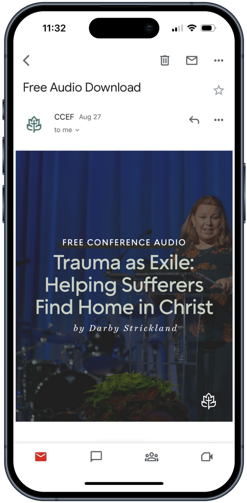
Sign up for our weekly email and receive access to a conference talk by Darby Strickland on helping trauma sufferers find home in Christ.
Loading form...