Christian Counseling & Educational Foundation
1803 East Willow Grove Avenue
Glenside, PA 19038

David Gunner GundersenJonathan Holmes
April 6, 2026
We're excited to announce Jonathan Holmes as our new Executive Director! In this episode, Gunner interviews Jonathan about his journey into biblical counseling, his background, and his vision for CCEF. They discuss the importance of counseling in the church, the founding of Fieldstone Counseling, and the future direction of CCEF.
Read the latest announcement from CCEF's Board of Trustees regarding Jonathan Holmes's recent appointment to the role of Executive Director here.
Mentioned in this episode: Becoming a Refuge is an on-demand teaching series that helps churches respond to domestic abuse. Learn more here.
In this episode, Jonathan mentions an article by David Powlison, "What Is Your Calling?" Journal of Biblical Counseling 28, no. 3 (2014). Find it here.
00:00 Introduction & New Resource Announcement
02:06 Welcoming Jonathan Holmes
05:23 Jonathan's Background & Family Life
08:51 Early Ministry Journey & Education
12:39 Founding Fieldstone Counseling
16:12 The Role of Biblical Counseling
20:06 Connection with CCEF
24:00 Teaching & Learning from CCEF
26:52 Transition to Executive Director Role
30:38 Vision for CCEF's Future
35:07 Closing Thoughts & Blessing
Hello, welcome to our CCEF podcast, Where Life and Scripture Meet. My name is Gunner Gundersen. I have the privilege of serving as the Dean of Faculty here. And before we meet a very, very special guest for today, I did want to share an important new resource with you that's launching this April. It's called Becoming a Refuge: Responding to Domestic Abuse in the Church. This resource has been developed by our own faculty member, Darby Strickland, and we're really grateful to make this available because there are people in our churches who are suffering oppression, and their suffering is really exacerbated by the fact that it's often misunderstood or it's happening in silence. And so Becoming a Refuge is an on-demand teaching series that helps churches respond to domestic abuse. So whether you're a church member, a ministry leader, or a pastor, this series will equip you and those who watch it with you with the knowledge and the tools to care for both victims and perpetrators of abuse. And it's meant to be watched together as a team or as a congregation. So when you purchase this resource, you'll also receive facilitator and discussion guides in addition to the videos so that you can determine together how to respond well. You can purchase access to this series on our website, ccef.org, and you will find the link in our show notes.
Well, it is a very exciting day on the podcast. I look around and green is breaking out everywhere. The Vernal Equinox has officially arrived. Spring is here and there are new things happening at CCEF as well. On March 26, after a careful and a prayerful search, our Board of Trustees announced the appointment of our new Executive Director. He is coming to us all the way from the great state of Ohio, and his name is Jonathan Holmes. And today we are welcoming Jonathan to the podcast and. more importantly, welcoming him as our newly appointed Executive Director. Welcome, Jonathan.
Thanks so much, Gunner. It's a pleasure to be here with you today.
Well, we are so grateful that you've accepted this call to join us. And we really wanted to take the time today to just give our listeners an opportunity to get to know you and to hear your heart for CCEF and your heart for our mission, restoring Christ to counseling and counseling to the church. So could we just start by maybe you telling us a little bit about your family, where you live, maybe some things that you enjoy.
Yeah, well, I've been happily married to my wife, Jennifer. We just celebrated our 20 year anniversary this past November in 2025. So we've been married for a little over 20 years. We have four girls. So I'm a proud girl dad. Ava, Riley, Ruby, and Emma. And they're 17, 15, 13, and almost 11 in a few months. So we'll all be in an odd year. And we live in Northeast Ohio in the Cleveland area. That's where my wife was born and raised. And I was somewhat new to the Midwest before I met her. And we've settled out here for the better part of a couple of decades. And we love it. It's been a really, really, really good home for us.
So being in Ohio, Northeast Ohio, are you now officially a Cleveland Cavaliers fan?
Oh definitely, definitely a Cavs fan. And Gunner, you know this, but, you know, I really don't have any type of sports ability or talent. And coming to the Midwest, realizing sports is such a big part of the culture, a big part of just what happens around here. I feel like I got inculturated very quickly. So definitely a Cavs fan, definitely a Guardians fan, you know, a not-so-enthusiastic Browns fan, but all-in-all, definitely a big basketball fan. A lot of my girls play basketball and someone like me who has, again, no athletic talent, it's just been a wonderful treat to have girls who enjoy playing sports, enjoy playing basketball, and that's one of my favorite pastimes.
That's great. What are some of the other things that you enjoy maybe as hobbies, outside of getting to watch your girls play basketball and enjoying their upbringing together with Jennifer?
Yeah, you know, it's probably not that exciting. I think most of the things I enjoy are just things either with people in my family or things around our homes. So, I love cooking. I love to eat, love a good meal, love how a good meal can bring people around the table. During COVID, to kind of help pass our boredom, like many other people who were in isolation, we started a little cooking show. So we would just cook recipes and film them with the girls, and it just turned into something and we now have a little social media account where periodically we'll cook and bake recipes. So definitely love doing that sort of thing, that's a huge part of our lives. I like reading books. I like gardening. I just like being with my family. Love watching a good movie too. So just normal everyday things that can be done with other people.
So subscribe to the Holmes Culinary Channel on Instagram.
Homes and daughters, yes.
Jonathan, could you just share some of the early parts of your story with us, maybe before the Lord called you into ministry, so that those that may not know you as well could just get a little bit of your background?
Yeah, well, I grew up in Alaska for the better part of my life. And Alaska, for those of you who have been there, you know two things about it: It is very cold for the majority of the year, and it's pretty dark too. So when it got time to choose a place for school, I knew I wanted to go somewhere that wasn't cold and wasn't dark. And so a couple of friends of mine were going to a Christian university in Southern California and it was near a beach or at least I thought it was near a beach. And so the beach plus sunshine plus friends. Ended up going to school at a place called the Masters University, and went there sight unseen. Met my wife there. That's actually where Jen and I met. That's actually where you and I met, where you and I connected for the first time nearly two decades ago which makes us sound both very old when you put years into decade language for sure.
It really does. Yeah, people might not know that we both graduated from Masters in the kind of early to mid 2000s and Jen and I served in student life together as resident directors. I was trying to, as a very young man, disciple young men in a dormitory called Slight Dorm and she was right across the parking lot trying to disciple the young ladies there in Sweazy dormitory. And that was a really sweet season as we learned kind of residential ministry together and you all ended up getting married. Also you were roommates later on with my brother, Mike. Shout out to Mike.
Yeah, that's right. I know. Yeah, it's, the connections are just wonderful. And I think that's one of the most delightful things about being in the body of Christ and just, you know, making these connections, is the paths so often intersect. And so, yeah, it's been a sweet thing to be able to have that shared background in history, Gunner.
Yeah, as I kind of continue to walk through life, I find myself reflecting more and more on Matthew 19 and the interaction with Jesus and Peter, where Jesus talks about having left everything to follow Jesus, and Jesus talks about all that he has received and will receive, and that really includes this whole new family. And I feel like the family of God is so vast and so beautiful to see how these providential reconnections happen over time by the Lord's leading.
Yeah, it's really sweet. Gunner, probably feel similarly, going to college was a really big turning point, I think, in my Christian life and just my friendships. I had never really been discipled. I never really had been taught theology. The church that I went to was a good church, but it was a bit more seeker sensitive. And so in terms of what discipleship and theology look like in everyday life, I really was a newbie. And so coming to Masters and having faculty members and student life people live life, literally live life with us in the dorms, in the classrooms, in the cafeteria was such a transformative experience for me that I would say in many ways really set the foundation for how I think about the Christian life, how I think about discipleship, how I think about the church. So when I look back on my time in undergraduate at Masters, I can't underscore just what a formative time that was for me and I'm sure for you and for many people who went there.
Could you talk a little bit about what took place after Masters and your graduation?
Yeah. So after we graduated, Gunner, like you were saying, Jen and you served in Student Life. I worked on campus in the admissions department, did some campus events, and helped the admissions department. But my brother-in-law was a youth pastor back in Ohio at a small church, and he knew that I had majored in counseling and I also majored in history. My thought was that my full-time job was going to be high school history teacher, or at least something with teaching history and that counseling and local church work would be something I would just do, you know, on a volunteer or in a lay capacity. So after our time at Masters had kind of come to an end, an opportunity came up for us to go back to Northeast Ohio, which was where all of our family was, and to kind of work bivocationally, try to, you know, get my teaching credential, find maybe some local Christian schools or public schools that I could work in, and then also on the side do a little bit of counseling. We moved to Ohio. The reason I remember it so vividly is we moved there on the 4th of July. So we pulled into town with our giant U-Haul of stuff. We got unpacked, watched the fireworks, but probably a couple of months into it at this small church, our senior pastor at the time had a really significant moral failure and had to step out of the pulpit. And again, I was in my very early 20s, my brother-in-law, who was the youth pastor, was also in his early 20s. And we both just looked at each other and kind of threw our hands up in the air. We had no clue what we were doing. We had no idea how to walk a church through a crisis like that. And so there was a large church about forty-five minutes north of us that had a well-known senior pastor named Alistair Begg at Parkside Church. And we hopped in a car, we drove up, we asked to meet with one of the pastors that was on staff. And our initial request was, can you just help us? We need pulpit supply. We don't know who's going to preach in the service in a Sunday. And could you help us? And Gunner, that started the seeds of one of the most fruitful and transformative partnerships. Long story short, over a yearlong process, Parkside really took over and kind of revitalized the church that my brother-in-law and I were at, replanted it as a satellite of Parkside Church. And during, right around that same time, the counseling pastor at Parkside Church was retiring. He was a faithful, faithful servant. He'd worked at the church, I think, for over 20 years and was needing to retire. And so they said, hey, we know that counseling at least is a little bit in your educational background, would you be open to a kind of helping fill in? And the rest is kind of history. I agreed to do that. I put the history teaching on the backburner as it were and started working at the two campuses and did not know a lot, but that is eventually what connected me to CCEF, because one of the first places that we reached out as we started really thinking about counseling ministry was reaching out to CCEF.
What a story. And I love how initially your idea was a little bit of counseling on the side.
Yes. Yeah, that's exactly what it was. I always, you know, when people ask you what you want to be when you grow up, I never would have told you, pastor or counselor. I really thought, I'll be a teacher and I love history. So, you know, it's God's providence and kindness and just goes to show at the end of the day that, you know, the Lord leads us where he leads us and his ways are good.
Now you're coming to us from Fieldstone Counseling, which is a ministry that you founded and that I know is very dear to your heart. Could you talk a little bit about how Fieldstone came about during your journey and then what you saw God do in your time there?
Yeah, so Parkside, our elder team and our pastoral team, every, maybe in the summer or in the late spring, the elders and their wives, they'll go on an elders’ and pastors’ wives retreat. And in the summer of 2016, we gathered together and we just spent some time together in prayer. And we said, what would be some ways that we could reach our community? We realized that a lot of the things that drew and attracted people to Parkside was, preaching, expositional preaching and teaching, but we really wanted to expand beyond that and really think about how could we make an impact on our community. And so we prayed, we talked, we shared a lot of ideas, we did a lot of SWOT analysis and whiteboard exercises. But one of the things that came out of it was, my brother-in-law said, hey, what do you think about starting a counseling center? So up until that point, we had a lay counseling ministry, and a lot of lay counselors would really help the people in the congregation with everyday issues and things that would come up. But when we would get requests from the outside, from other churches and communities, we would have to turn them away because we just didn't have enough counseling availability and help. So the idea of a counseling center kind of came up in those conversations of, hey, what if we started a center that was more community and forward-facing and served other local churches? And so that was in the summer of 2016. We spent a whole year doing a lot of research, a lot of just looking and having conversations with other people who were doing similar things. And so Fieldstone launched in 2017 with a team of about six counselors outside of the two main Parkside campuses. And we just started opening up our doors to the community. We didn't even know who would show up. But in our first year, by God's grace, we were able to meet quite a few people. The big game changer for us though was during COVID. So one of our counselors right before COVID had happened had started to look into remote counseling. Like what would it look like to do counseling via Zoom or Google? And again, pre-Zoom and pre-COVID, we all thought, oh that seems kind of weird, like, you need to be in person. But we decided to dip our toe into the water of it and did a little bit of video counseling and remote counseling, and then COVID hit. And again, like everybody else, within a week we had to completely quarantine. And by God's grace, we had already been doing some of the counseling online that within that week, we were able to switch our whole counseling load to online with little to no trouble. So that just kind of, that just helped us realize that we didn't need to constrain ourselves to just Northeast Ohio. And so over the past nine years, the team's grown. We have 46 counselors, about half of which are in Northeast Ohio. The rest are spread out across the country. And in nine years, we've done about 70,000 counseling sessions. So we are able to help people in all 50 states, 26 countries. Our mission is to help people both have access to biblical counseling, as well as to be able to afford it wherever they might be.
At what point in your journey would you say that you started to see that biblical counseling was going to be a central part of your life and something you were going to pour into? I know you're hard and obviously as you get into pastoral ministry you're going to be doing counseling and you're going to be individually, personally shepherding people and helping couples and families, etc. But was there a point or a season in which you realized, this is becoming a much bigger part of me and my vocation now?
Yeah, Gunner, that's a good question. You know, if I had to track it back, I might come back to, again, what we were just talking about a little bit earlier of when I first came to the church that I came to and our pastor having that moral failure. You know, within a year's time, there's a small congregation of people and the amount of just heartache and hardship and suffering that that small congregation went through was just enormous. I can just remember coming home from work after being in meetings all day with members of the congregation who were just devastated, whose entire worlds had been completely unmoored. And just in having those conversations, you just begin to realize, man, I'm not equipped to be able to engage and interact with all of these hurts, all of these troubles, all of these betrayals, all of the things that the people were being faced with. And so I was forced to dive into God's Word. I was forced to look into resources like we have at CCEF to help me navigate some of those conversations. But what became clear is that counseling, I think in its purest and simplest form, it's a form of discipleship, right? It's a form of coming alongside another person, knowing them, knowing Scripture, and knowing how to connect those two things together. And I've always enjoyed interpersonal ministry. I never saw myself, I think, long-term as a preacher or a pastor. But the one-on-one dynamic, I think, was something that I realized there's something here, and there's something here that by God's grace I want to continue to grow in, in terms of being able to open God's Word and minister it to everyday people.
I always love hearing people's stories because when we talk about calling and vocation, it's so rarely linear that you kind of think that you have this linear plan that you're envisioning when you're younger and you have the steps perhaps laid out or at least the next step and you think you have a sense of where that might lead. And then looking back, you can see in hindsight the way the Lord connected dots, but so rarely are those things linear, and many of them have to do with real trials or surprises or challenges, twists, and turns that you couldn't have anticipated. And it's just always sweet to see how the Lord is laying those things out before us before we even know what that path will lead to.
Yeah, absolutely. It's that golden thread of God's providence because, yeah, when you're in the midst of the trial or the valley or wherever you might be, it's very rare for you to be able to have that kind of eternal mindset or long view. What you feel is you feel the pain, you feel the hardship, you feel the paralysis. But when you look back on it in hindsight, and you can be a couple of years or even a couple of decades removed from it, what you see is this is the steadfast love of the Lord who's at work in our lives, who's at work in our circumstances or churches or worlds. So it really is a wonderful thing to be able to look backwards and forwards together.
Now you might be new to some of our audience, but as you've mentioned a couple times already, CCEF is not new to you. Could you just talk about some of your first encounters with CCEF and some of your roles with us that developed over time?
Yeah, well, like we had chatted about earlier, my first connecting point with CCEF was in the fall of 2008. So after we'd come out to Ohio and the churches had begun this partnership together and I took over the counseling role, the first question I thought of was, how do we even start? How do we even begin a healthy counseling ministry? How do we even educate people on what counseling is? And at that point, I knew there's really only one place to go. And so we went to CCEF, we reached out to Ed Welch, and Ed Welch came out to Parkside in the fall of ’08 and he did a conference. I don't even know if Ed has done a conference like this before, but we just asked him to talk on five topics that he could choose. And he just picked five different counseling topics. One was on psychology and theology, he did one on anxiety, he did one on marriage, one on relationships, but for us at Parkside, it was revolutionary. We had never heard that kind of teaching before, which took good preaching, good exposition of the Word, but brought it down into everyday conversations, and being able to see how God's Word interacts and engages, not just the big things, but also the little things of our lives. So that started really in 2008 a wonderful and really fruitful partnership. From there on out, really on an annual basis, we would bring out a different faculty member from CCEF and just have them speak on whatever particular topic, whether it was children and adolescents and Julie Lowe, or marriage, Winston Smith came out and did a marriage weekend for us. We just really benefited from CCEF's heart and mission to see counseling restored to the local church. One of the unique things though that I would say I think has marked out CCEF and at least my interaction is that the people who came and spoke at those conferences didn't just remain conference speakers or people from afar that you read their books. They were helpers. So as we would run into everyday problems or need help with a particular issue, just being able to reach out to them for advice and counsel and consultation was, Gunner, it was such a treasure for us. I think over time, those relationships and friendships just bore more fruit and so I've had the opportunity over the years to come to conferences, present at conferences, eventually I was able to teach as a visiting faculty member in the MAC program. And about six years ago, I joined the Board of Trustees. And it's been one of the greatest privileges and honors of my life to not only know the people of CCEF but to serve them in those various capacities. And just to know the mission and the people of CCEF I think is a really sweet gift that the Lord has given.
Yeah. I've always thought that some of the people that make the best youth pastors are those that had a great youth pastor who invested in them because they've experienced it and they've tasted what it looks like to be loved and cared for and discipled and walked through a fairly tumultuous time of life in adolescence. And I think it's really sweet when people are able to reinvest in a ministry that has invested so much in them. And that's my testimony as well. They're in the mid-20s beginning to attend conferences or having a CCEF speaker come out to chapel and perhaps getting to engage with them as a staff member and soak up that wisdom, but also the way of engaging along with the careful teaching that was so meaningful. And so I'm so grateful that you've had that experience as well.
What were some of the things that maybe you appreciated most about some of the teaching and some of the ways that people were understood and the Word was engaged with that just drew you to CCEF in those earlier years?
Yeah, that's a great question, Gunner. And you and I come in from a similar, I think, undergraduate theological background. I think we probably got a very good foundation of theology, but sometimes the dots that didn't get connected, at least for me, was how does this connect to everyday people in everyday situations? Like, how do we bring what we hear on a Sunday, and how do we bring it into a Monday lunch with your coworkers? Or how do we bring it into a playgroup with other moms on a Thursday afternoon? And for me at least, from the writings and the teachings from the faculty at CCEF, what has always stood out to me is a deep interest and a deep care for the person in front of us, for the image bearer of God that the Lord has placed in front of us, either as a colleague, a coworker, another mom in a Bible study, or a dad in a group.
CCEF has, I think, done such a wonderful job at seeking to know people, know their hearts, know their circumstances, their situations, their struggles, their temptations, their desires, their hopes, their dreams, and then taken that and then connected it to Scripture. And I love one of the things that we talk about at CCEF about mining the treasures of Scripture for the troubles of life. And to me, I'm like, man, that is what I'm after and that is what is so attractive to me about CCEF. All of us have troubles, right? There's not a person that you or I will meet today that has not experienced some kind of trouble in their life. And to be able to know how to wisely and winsomely take God's Word and bring it into a conversation or bring it in an interpretive way into a person's struggle, that is something that has been immensely helpful to me and that I've, I’ve been a student of and that I've learned from the faculty at CCEF. And I think that when you read our materials, when you listen to our talks, there's a richness, there's a complexity to the human experience that moves past caricatures, that moves past, hey, if you just do this or if you just read this or just pray this, that is a starting point, but that's never the endpoint. We always want to go deeper. And so for me, that's been immensely attractive for me in CCEF’s ministry for sure.
We've talked a little bit about some of your background, getting married to Jen, your undergraduate years, bivocational ministry early on, or at least the move toward that, and then the Lord calling you to serve in pastoral ministry, founding Fieldstone. Can you talk now a little bit about just your calling to this new role as Executive Director, maybe walking us through that? How did it start? What were maybe some key moments in the process? And was there maybe a tipping point for you that kind of led you to take this on?
Yeah. You know, some of the things maybe that you've heard from my story is I think a lot of the major moves in my life have come somewhat unexpectedly. So, you know, the situation at our church, how Fieldstone came about, all of them have just been, I think from my vantage point, just the Lord opening up a door and me sensing a need or a calling, people in my life sensing, maybe some gifting and some affirmation of that calling and just encouraging me to take that next step. I think when I thought about CCEF and thought about the opportunity, you know, what first came to mind was just, man, I'm not able to do this. You know, who is able to do such a thing? And I think in that regard I felt very much like the apostle Paul in 1 Corinthians 2 where her, I just imagined him kind of throwing his hands up in the air and saying, you know, who is sufficient for these things? So I felt that deeply. I had a lot of internal anxieties and fears and imposter syndrome. But at the end of the day, one of the things that helped me was actually a journal article from the JBC. It's an article I would actually use a lot in counseling from David Powlison. It's called, “What Is Your Calling?” And in the journal article, he asked five different questions to help people discern their calling. And a couple of the questions, at least for me in my life, have been formative. One of the questions is, you know, what do other people see in you? What are some of the gifts that people affirm? And so that's been helpful as I've had to maybe battle some of the internal anxiety and noise of my own heart to be able to turn the volume down a little bit on that and to seek out wise counselors, to seek out the friendship and support of people who know me and who know my heart. That's been a critical piece. Another one of the pieces that he talks about is what do you want to do? Just what's your desire, what do you want to do? And when I boil it down to that, one of the things I kept coming back to was I do have a deep love for CCEF. And I think that that love has been born out of, it's changed my own life, I've seen it change the life of people in our church, I've seen it change the life of people in the organization that I lead. And by God's grace, Gunner, man, if there's, if I can even play a very, very small role in helping serve and love the people of CCEF and help lead them in the next season of ministry, that would be such a joy for me. So I think after I worked through some of the initial internal fears and anxieties and asked myself some of those questions with the help of counselors and friends, I was able to say, hey, here's the next step that I believe the Lord's calling me to that I'm willing to take.
Well, thank you for wrestling through it and accepting the role. As you were sharing, I was thinking that just in the same way that the big picture of our lives is not linear, also these chapters in which God is working in our hearts to call us is also not linear, that there is a back-and-forth process, a real wrestling and moments where we think something can go one way and moments where it may go another way as we weigh things and seek counsel and prayerfully work through that. And it's just special to see how the Lord leads us both in the bigger picture of our lives over decades and also over seasons of days or weeks or months where we wrestle with what his direction is for us personally.
Could you talk a little bit about just your heart for CCEF and for our future? I know that you're just coming into this, but what is on your heart when you think about how you hope to lead forward and what you hope CCEF will be characterized by and what we'll focus on?
Yeah. Well, when I was making the announcement and filming the announcement and thinking about that very question of, okay, what is the heart for CCEF? Again, the two words that kept coming back to me were people and mission, the people of CCEF and the mission of CCEF. I love the people of CCEF. Again, even before coming into the role of the Interim Executive Director, a lot of the people at CCEF were friends, they were colleagues, they were people that I had sought counsel from, that I would be in conversation with, so being able to now serve in this role, man, it's a dream, it's a real treat. And there's something about the people at CCEF that motivates and animates me to want to serve them well so that they can go and serve the people that they are involved in relationships with well. So whether it's people that they're influencing and impacting in the classroom or in the counseling room or people that they're discipling and mentoring. Again, it's that wonderful chain of grace where if I can be of service in helping lead the organization towards greater fruitfulness in this season of ministry, then that's a joy for me to be able to do that.
I would say the other thing about CCEF is the mission, right? There's, I would say, simplicity about the mission of restoring Christ to counseling and counseling to the local church, but the endless opportunities and possibilities, especially with the second half of the mission, I just think to myself, oh my goodness, sky's the limit, right? Like what are all of the different ways that we could help local churches be impacted by the kind of counseling that CCEF is about? And Gunner, you and I both have been pastors before. Our heart, I think, is very much for the local church. The needs of local churches, they're diverse, right? Every church in America and across the globe are different and have different needs. And so I know one of the very first things that I would love to see CCEF do is just engage in conversations with local churches. Tell us about who you are. What are your needs? How can we serve you? Right? At CCEF, we are not the place where we would say, hey, we have all the answers. We've got it figured out and we're going to come to you with this, you know, special program. Just do it and you'll be fine. No, I think our first posture will be one of engagement and humility and understanding of help us understand what are you already doing that's working and how might we come alongside you and better resource you, support you, pray for you, help you? To me, that really is energizing when I think about just the frontier. When you think about how many churches, right, there are in the world and you think about, what does it look like to restore counseling to the local church? To me, that just seems like such an exciting opportunity for not only the people of CCEF, but for all of the people who help support, who donate, who support us through their prayers, you go into those situations with us. You go into those counseling rooms, into those local churches through your support. So that really motivates me and I'm excited to see what happens not only in this next year, but in the years to come for CCEF.
I could not agree more. So many times during my brief time at CCEF so far, I've thought back to the brothers and sisters at the church where I had the privilege of pastoring. And I think of the things that they're facing, the ways they're growing, the various trenches of life in which they find themselves, the different relational challenges and opportunities that they have, their vocations, their families. And I think what a beautiful thing to be able to support local churches and seek to encourage them as they seek to encourage one another as a local body of Christ. And I'm just thrilled with the vision of CCEF of restoring Christ to counseling, but also restoring counseling and this relational conversational discipleship-oriented ministry to local churches to strengthen that. And you're right, local churches can be so diverse, even though human nature is the same and the gospel impacts people in the same way, it's also very, very detailed in the way it works out in our different lives and in our different cultures and locations and sizes and structures of churches and all sorts of things. And I'm just very thankful for that mission and that's something that excites you.
Yeah, me too.
Jonathan, as we come to a close here, is there maybe a verse or a passage that has been on your heart recently as God moves you into this new role?
Yeah, I've been reading through the Psalms devotionally along with one of my other Bible reading plans. I've been trying to just move through a psalm a day. And I shared this recently at a staff prayer, and Psalm 62:8 just stood out to me, I would say, especially in the past three or four weeks as I've been thinking through the decision to come to CCEF more permanently. And, you know, as I've been working through some of those internal fears and anxieties and thoughts that I was talking about earlier, Psalm 62:8 reads like this, the psalmist says, “Trust in him at all times, O people; pour out your heart before him. God is a refuge for us.” And it was really that middle line in that stanza that has just touched me of pour out your heart before him. And I think of a God who's sovereign and wise and powerful and omnipotent. And I read about a God who gets so personal with us that he would come to us and say, pour out your heart, right? And it's not just, hey, you know, I've got five minutes, can you just give me the executive summary, you know, of all your troubles, which I could do. Psalm 62:8 came to me and it was, tell me everything. Just pour out your heart. Just dump, like what is on your mind, what is on your heart? And, you know, just in my own prayer life, in my own devotional life, I think over the past few weeks, I've been able to do that, of just saying, God, here's everything. Here's all of the good, the bad, the hard, and the ugly. And the ending of that verse is what we need, because it'd be one thing if we just verbally throw up and share everything. It's the call to do something at the end, which is so helpful, where the psalmist says, God is a refuge for us. So the movement is, I pour out my heart before the Lord and I draw near to him, and he becomes a refuge for me. And I've felt that, I would say, especially over the past few weeks as there's been a lot of transition and communication. You just realize very quickly how limited we are as human beings. And I think I felt that limitation and that finiteness. And so this has been, I would say, such a kind invitation from the Lord to just say, hey, tell me everything, pour out your heart, and I'll be a refuge for you.
Well, brother, thank you so much for coming today and sharing a little bit about your story and your heart and your heart for CCEF. We're excited for the future and really thankful that you're joining us.
Thank you.
I want to close with a blessing that the Lord gave to Aaron and the priests in Numbers 6 to say over the people. And I'd love for this just to be a blessing specifically for you and for your family as you make this change. And so I'd like to read this in closing. “The Lord bless you and keep you (and Jennifer, Ava, Riley, Ruby, and Emma). The Lord make his face to shine upon you and be gracious to you. The Lord lift up his countenance upon you and give you peace.”
Dean of Faculty
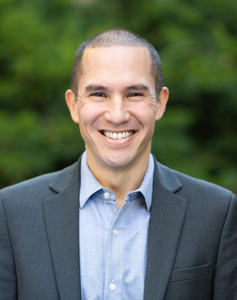
Gunner is the Dean of Faculty at CCEF, where he has served since 2024. He holds a PhD in biblical theology from the Southern Baptist Theological Seminary and a master of theology and master of divinity from the Master’s Seminary. Prior to joining CCEF, Gunner served as a lead pastor for seven years, after working for fifteen years in Christian higher education as a resident director, director of student life, associate dean of men, and biblical counseling professor. Gunner has a passion for helping believers live consciously in the story Scripture tells, equipping the local church for interpersonal ministry, strengthening pastors, and biblical preaching and teaching. He has published the Psalms notes for The Grace and Truth Study Bible (Zondervan, 2021), What If I Don’t Feel Like Going to Church? (Crossway, 2020), and numerous essays and articles on the Psalms and adoption.
David Gunner Gundersen's Resources
Executive Director
Jonathan Holmes is the Executive Director of CCEF as well as the Founder Emeritus of Fieldstone Counseling, where he served for over nine years. He also previously served on the pastoral teams of Parkside Church and Parkside Green for fifteen years. Jonathan graduated from The Master’s University with degrees in biblical counseling and history and received his MA from Trinity Evangelical Divinity School. He is the author of and contributor to a number of books, including The Company We Keep, Counsel for Couples, Rescue Skills, Rescue Plan, and Grounded in Grace: Helping Kids Build Their Identity in Christ. Jonathan has written for Christianity Today, The Gospel Coalition, the Biblical Counseling Coalition, the ERLC, and CCEF’s Journal of Biblical Counseling. Jonathan serves on the Advisory Board for the Association of Biblical Counselors (ABC) and the Council Board for the Biblical Counseling Coalition (BCC). He is an instructor at Westminster Theological Seminary in the Master of Arts in Counseling program, and he speaks frequently at conferences and retreats. He and his wife, Jennifer, have four daughters.
Jonathan Holmes's Resources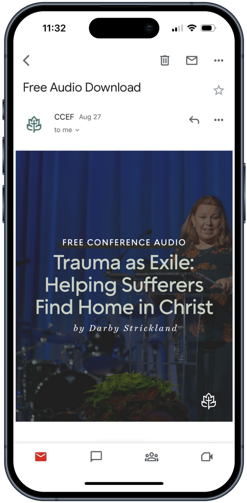
Sign up for our weekly email and receive access to a conference talk by Darby Strickland on helping trauma sufferers find home in Christ.
Loading form...
