Christian Counseling & Educational Foundation
1803 East Willow Grove Avenue
Glenside, PA 19038

Darby StricklandDavid Gunner GundersenEsther Liu
December 3, 2025
In this episode, CCEF faculty discuss the often overlooked issue of stagnant marriages, exploring the subtle signs of disconnection and the importance of intentionality and spiritual friendship in marriage. They emphasize the need for curiosity and community support, as well as the difference between a covenant and a contract in marriage. They highlight practical steps couples can take to revitalize their relationships, including small gestures of love.
Mentioned in this episode: If you've been encouraged by our podcast this year, would you consider giving a gift to CCEF today? Your support would go to immediate use today to help equip the global church for thoughtful, biblical conversations about matters of the heart.
00:00 Introduction
01:16 Recognizing Stagnation in Marriage
08:34 Frameworks for Renewing Marital Connection
11:54 Covenant vs. Contract in Marriage
18:40 Navigating One-Sided Efforts in Marriage
23:30 A Brief Word to Husbands
30:44 The Role of Community in Marriage
39:07 Closing Thoughts and Encouragement
Hello and welcome to our CCEF Podcast: Where Life and Scripture Meet. I'm Gunner Gundersen and I have the privilege of serving as the Dean of Faculty here at CCEF. And I'm joined by my colleagues, Esther Liu and Darby Strickland, also faculty members at CCEF. And we hope that you've really been helped by the conversations that we've been having throughout 2025. Maybe you've recommended an episode to a friend, maybe someone else has recommended one to you.
If it has been helpful, could we just invite you to consider a financial gift to CCEF? With your help, we are committed to equipping the church, not only in the US but around the world, for thoughtful and biblical conversations about issues of the heart, issues of relationships, issues that are relevant to every believer and their walk with Christ. If you're interested in that, please take a moment to visit ccef.org/donate. That's ccef.org/donate for more information and for ways to give. And we're just so grateful for your partnership because our ministry is fueled by partners who are really passionate about applying the treasures of Scripture to the troubles of life.
And today we really want to talk about what could be considered a trouble of life, but it can become normal enough that we might just exist in it. We might not even realize consciously day to day that this is where we're at. But probably on a fairly regular basis, we have this realization, this is not all that it's cracked up to be, this is not all that I would hope it is. What we'd to talk about today is just when marriage seems stagnant or disappointing, distant, maybe disconnected, not necessarily the more extreme problems in marriage, which we address in other places and other times, but when your marriage is just surviving, but it's far from flourishing. So just to start out, what can it look like? What can it feel like when a marriage is stagnant or when it's disconnected or when it's just surviving?
I think it’s really good to think about and pause on. Because you can have a really busy life and your marriage still not be thriving. You could be doing a lot of activities, taking care of children, friends have a very active calendar, but not really, your relationship isn't thriving and growing and sustaining. So when I think about that, at the intro, Gunner, I was thinking about marriages that are meh. The relationship just doesn't have enough to it that you're looking forward and longing to it. And I often think of like when your conversation with your spouse just kind of quickly turns to logistics instead of how you're doing or how their heart's doing. Again, just places where conversation isn't going deeper. You're not feeling heard. I know a woman in my life often says when her husband's eating cereal and his loud chewing annoys her, it's a signal that there's something not right in the marriage. And it doesn't mean they had this huge argument. It usually just means that they haven't had time together. So when small irritations become large, because the relationship is whittled down to smaller things than it should be.
Darby, I really appreciated when you initially proposed this idea to our team to talk about. And I think one of the first things that came to mind when you proposed it was how often when we think of struggling marriages, we think of marriages that are high conflict, very escalated fights, constantly arguing, whatever that might be, or again, some of the more extreme issues that can come up in marriage that are very heart wrenching. And yet there is a category of marriages that isn't necessarily marked by constant fighting and bickering and escalated arguments and all these other issues. But it is the kind of daily wear and tear, the kind of low-grade resentment, the low-grade “we keep getting into the same issue, we're not really figuring it out.” This low-grade sense of, I feel like I'm doing more than my partner's doing. I feel unsupported or I don't feel understood or seen in a lot of the things that I'm trying to do in this marriage. Something that doesn't necessarily have to be characterized by like hot, heated interactions, but maybe even dynamics that feel a little bit on the colder side. That there's kind of a general avoidance or maybe even some passivity, some resignation. Like this is just how it is and I guess I just need to come to terms with it. So I just appreciated this topic because it opened up an entire category of where marriages can really struggle that isn't necessarily where our minds immediately go to if we think of a marriage that needs help and prayer and support. So, yeah.
There have been seasons in my marriage where I've realized looking back, I was coasting, but I didn't realize I was coasting or I wasn't paying attention to it because I didn't see that smoke coming from under the hood. I didn't see this consistent conflict or these heated moments. And so I convinced myself that everything was good. Almost there was this sense of placid peace instead of realizing that actually there may be a greater sense of distance than I realized or it might not be the level of connection that would honor the Lord and would really honor and give just a pleasing relationship to my wife, a dignified relationship, a meaningful friendship. And it was important for me to recognize that the signs of a marriage that was coasting and a husband that was coasting were more subtle. And it was important for me to start to recognize those and have a more delicate perspective on how I think about our marriage and where it was at.
I would say, Gunner, it’s for me, raising three kids, homeschooling them, having my middle child with developmental disabilities. We probably had therapists in the home five, six, seven times a week. So for me, I was just too busy even to see that the marriage wasn't flourishing. We didn't have time, right? And every interaction, every meal, there was something with this particular child getting our attention that needed to be addressed. Like our family rhythms were all about supporting this child and getting things stabilized. So it was just a sheer busyness of that season. It just took a toll on us individually, but also corporately. I don't think, we couldn't look up, right? We were just both so drowning in what the Lord had placed us in, my husband being in ministry at the time. The needs were everywhere and it was really easy to forget to think, oh, what does my spouse need from me?
We've had similar situations when for example we had all teenagers, and it felt like every night it was driving lessons or preparing someone for a job interview or attending an event or a game or having a significant emotional conversation about something relating to school or relationships or romantic interest. And it just felt like that was all-consuming and there wasn't really any out from that. And you don't get any timeouts, it feels like, even though there are strategic small things that can be done. And so I remembered seasons like that where there could be even an awareness that it's really hard to have the time and the space to be able to be together in the ways that we would like or to work together on the things that would help our marriage grow deeper.
Yeah, and I think of other friends of mine who struggle with this because their spouses don't know how to meet them, right? They just either don't possess the knowledge of how to enter in and be a good friend, they haven't seen that modeled, or they have some neurological diversity in just the way that they're able to be present in a conversation, either they can't attend to detail or they're not picking up on certain things. And so there's all sorts of reasons why people can be together but not together.
Can we talk about some different frameworks or lenses that can help give us a better perspective or a refreshed, renewed perspective on our own marriages, on our roles in those marriages, and how we can take small steps toward flourishing together in biblical ways?
I do feel like we're already starting to get at that even just by naming some of the common struggles that can arise in different seasons of life too. I appreciate both of you kind of identifying a certain season of parenting and your children being a certain age or going through certain struggles. And I'm witnessing my brother and sister-in-law navigate a different season of parenting where they're younger and it's birthday parties and dance classes and dropping them off, picking them up. And then one is like at the same time as the other, so they have to coordinate the transportation of who's doing what and when and all the logistical details. But yeah, just recognizing the different seasons that marriages can have, and a lot of that is based off of different seasons of even parenting and the ages of our kids and what they happen to be going through. But I do appreciate the naming because so often it can start to run on autopilot. And so even slowing down to say, what are the potential pitfalls that marriages can run into? What are these words that I would actually take the time to process is actually characterizing my marriage, even if like you said, Gunner, there's no smoke coming out of the engine. But even taking a step back, taking inventory, and saying, how would I think about marriage and how I've been connecting with my spouse lately? How would I actually start to name some of those dynamics that maybe feel so normal and so like, this is just how we do things, but actually are ways that the Lord might be inviting me to consider better and more flourishing things to move towards. So I do feel like so much of this is even taking that time to name and articulate for ourselves, take inventory of, where are we right now? Where is this marriage right now? How am I doing as a spouse right now?
I think the category that's been really helpful to me is, are we good partners? I can check yes to that, like throughout the course of my marriage, but is our spiritual friendship growing? That has just been a much more challenging question in certain seasons. So it's the idea of sometimes we can think about our marriage as a business relationship, because we have all these commitments, budget, relationships, right? There’s limited resources, we're making decisions and we're seeing the people under us flourish, we're managing our responsibilities well, but is our friendship growing in the midst of that and how are we spiritually fortifying one another? And I think that has just been really helpful to me to take a different level of inventory. And that's one of those categories, I think, that's helped me reframe how I might fill my calendar or how I need to be praying for my spouse and spending time with them.
Something that I've been hearing a lot in my premarital counseling is my premarital counselor continually bringing up the phrase contract versus covenant and saying, ensure and pray and prepare your heart that you are making a covenant and not a contract. And I think one of the things that he's trying to get at there is how often marriages, any relationship really can become an arrangement of, if you do this for me, I'll do this for you. If you don't do this for me, then I don't want to do this for you. And how often relationships can slip into that kind of mindset and how much marriage, the reason, the covenant that we're making before God is something way more and in a lot of ways, way harder than if you scratch my back, I'll scratch yours too. So that's certainly been on my mind as a very humbling and sobering reminder of what marriage really is and what that commitment is that is so weighty and yet beautiful at the same time.
That's just a great way to guard against resentments because there are going to be seasons where one person is serving and striving harder than the other. It's just by nature, right? We always say in my home, only one person's allowed to be crazy at a time, usually because someone is and the other person is going to be carrying the other. But I think that Tim Keller, he says it so well, like, we don't love people because they're useful to us, right? God gives us a way that we move towards them because Christ move towards us. Or Ed has said this unbalanced love ,and I just, that phrase from Ed has just really stuck with me. Just this unbalanced love. I'm called to love in an unbalanced way because that's how the Lord has loved me. And that can revive my marriage and inoculate me against some of those resentments.
When I think about a contract, a contract tends to function as a ceiling. So I'm not going to go beyond the terms of the contract. I'm just trying to basically meet them. And there's so many other things to that that are unhelpful when we think about or approach a marriage. But I think of a marriage is something where the vows that we've made together serve as kind of the floor. They're the soil, the garden in which a sacred relationship grows. And I'm wanting to help that flourish in all sorts of little micro ways, not just the big ways that I'm expected to keep and wouldn't want to go outside of because that would be scandalous. It's actually those smaller ways of cultivation that are so deeply meaningful when I really see Cindi and I want to know her not as a wife, but as my wife and as Cindi and as who she is as a person and who she is and who God is growing her to be through each season of her life, because who she is develops and changes as she takes on responsibilities and new relationships and things ebb and flow in life. And so that's such a different view as the Lord keeps reminding me of that, than the view that just sees a basic ceiling of things that I need to get done. The other thing that stands out to me is that in a marriage, we each settle into our kind of functional roles. And I don't just mean really overarching, broad male and female roles, husband/wife roles in a marriage. I mean, who we are in our personalities and the way that our home operates. And it just can become very easy for those to become the unspoken checklist of things that I basically need to take care of or do instead of thinking of this as a special organic relationship and as you said, Darby, a spiritual friendship where I want to be seeking her and loving her well and receiving her love well in ways that are not just bound by the typical ways that we do things.
As you're talking, Gunner, it made me think of a lot of marriage books that I read during my premarital counseling time many years ago. And it actually focused a lot on roles. And there was like a lot of negotiation about tasks around the home and all sorts of things, but what would your role be? And I think they just missed—I think we're different now when we look at the marriage books that are out now. We're looking at our spouse through a different lens, as a person that someone we’re supposed to get to know and encourage and love and sacrifice for. But it's just, again, it's just so easy to reduce it to tasks or complacency, like what you're saying, like with myself, that this is just how I am. Versus who do I need the Lord to shape me into to bless my spouse? We don't typically think that. I know my husband loves Star Wars, and I really don't love talking about those movies. And he banters back the lines back and forth, and the kids are home and I'm thinking, what's going to happen when they're all gone? I'm going to have to take up a love for this because it just brings him such delight, right? But it is those silly things that a friend would do that are just as equally important when you see your spouse take joy in something. You want to be able to participate in that with them, even if it isn't something that is your preference.
One of the best things about marriage is that I'm called to be a growing version of myself instead of a stagnant version of myself. And there's so many different areas of marriage where I could easily say, and I'm tempted to say, I'm just not strong in that by my own personality. That's not how I prefer to relate or that might not be the activity or the thing that I prefer to do. But in doing it and in enjoying Cindi doing it and in really getting to know her, I'm just exposed to so much more of life, and it's a blessing. And through her enjoyment of something, I'm able to enjoy it myself and enjoy her doing it. And it just expands who I am in a way that is actually very meaningful, even if before those moments, there can be a sense of, this isn't really me. But I'm grateful that the Lord isn't just leaving me me. And I think that also really challenges me to continue asking, in what ways is God calling me to grow beyond where I am right now, instead of just being stagnant?
Can we talk for a minute about how we might try to approach this kind of relationship when one spouse maybe doesn't want that kind of spiritual friendship or doesn't seem ready to pursue it when there is not a both-sides approach to this dance that we're talking about?
I think one thing that's really helpful, having counseled a lot of women who say to me their marriage feels like a desert, or they're sharing a home but not a life with a partner, just reminding them of the deep, rich friendship they can have with Jesus. Not just that he can be the friend and is faithful to them, but also he knows what that unreturned love feels like. He knows what it is to walk among people who don't know him or understand him or draw him out. And that's just been really helpful just to remember they're not truly alone. They can foster that friendship with him. Then I find it's just helpful to think about, is your partner unwilling or are they unable to? Like can't versus won't. And that can be a really painful process of discernment, because we want to believe they’re, yeah, it's just a very painful process to discern which is the case. Do they not want to, or is there some weakness or a lack of capacity? And I feel like that process takes time, just be asking the Lord and others in your life for wisdom to try to figure out what's going on, why isn't this person joining in?
It is interesting or significant that regardless of what that reason might be, it's really important and helpful to discern what's underlying that, whether it's unwillingness or inability. Yet the end result of that so often is that experience of loneliness, that experience of, I would love a spiritual friend, I would love my spouse to be that person for me, but they're not for whatever reason that may be. You know, I've reflected so much of how difficult, and maybe in some ways I want to say impossible, marriage seems and just the amount of courage and fortitude that's required to continue to move towards someone whether those obstacles be, it’s out of my comfort zone. Gunner, when you're talking about, you know, trying to enter into someone else's world, even though that's not naturally how I'm wired, the amount of courage and vulnerability to get out of what's familiar and what feels like my strengths and what I prefer or what I feel like I'm good at and to be willing to enter into a world and things and activities. And I don't know, I keep thinking of Ed Welch and his example of like his wife loves dancing and the vulnerability of if you're not a good dancer, but then your spouse loves dancing, you know, it's not easy. And I think the how difficult this really can be in practice and in actuality is so true. We could commit and want to move towards so many things for the good of our marriage, and yet so often what can be a barrier is, this feels scary, this feels vulnerable, this is out of my comfort zone, and just the hardship, the hardness of being able to continue to move towards and do those things that are costly, feel impossible unless there is a really compelling reason to move towards that. And I feel like what's been really helpful in reflecting on different relationships where moving towards becomes painful is what you were saying, Darby, is that relationship with Jesus and knowing his relationship with us and knowing that we are recipients of something that is glorious and beautiful and one-sided, imbalanced, where he moves towards us before we even move towards him, where he loves us even when we're a mess, even when we don't deserve all of those things, all of those things that are embodied in Christ that we are recipients of. I feel like that's the only way that I can imagine for my own life and my own barriers in relationship that I can continue to move towards that is knowing that someone has done that first for me.
And knowing that I'm consistently pursued by the Lord who pursued me first and continues to does have a warming effect on my heart and it changes my heart and it also motivates me outward to want to pursue in that way. And if I could just say a brief word to any men who might be listening, I would just say I have found that many of our wives are waiting for or eager for or hungry for a more intentional pursuit and a greater proactiveness from us as husbands. And I know from experience that it can sometimes feel like I'm not great at whatever it is that I'm being called toward, but it is such an opportunity for me to grow in the Lord and such an opportunity for me to rest in him and trust him and ask for his help and to practice humility and say, Lord, please help me learn how to better love this woman that you have given me as a tremendous gift and help me to grow in sensitivity, in pursuit, sometimes in bolder leadership where it's important to work together more proactively towards decisions about what the future might look like or what we're gonna do for schooling for the kids or how to address something that's pretty challenging in one of our lives, or where we're going to go to church as we're in the midst of a church transition. It could be a tenderness and a delicateness and a greater listening ear or more time spent. It could be a greater decisiveness and a healthy sense of assertiveness to say, hey, I want to work together in a more purposeful way that gives us together a sense of clarity about where we're headed or what we're doing. Those things are real acts of service, and they don't need to be and they won't be perfect, but it's important. And one thing I've learned in that process is that when I've sometimes tried to make changes, because I realized that for myself, some changes are needed, there's times when I just haven't communicated that to Cindi and I've just tried to start making changes, even small ones like, I'd like to have this kind of conversation, but we don't have the shared muscle memory for it, but I just start doing it. And then there isn't the kind of reciprocity instantly that I'm hoping for and it doesn't resonate like I'm hoping for. And then there can set in a sense of defeatedness or frustration that I'm trying, but it's not working. But what's happened is that the same music is playing and I just changed the steps to the dance and I didn't communicate that. And so I've learned that I want to change together with Cindi and for her to know what's happening as I seek to grow in some way. And that allows me to get feedback from her. Is that helpful? Is that less helpful? Can you help me understand your perspective on this? Can you help me? Because I need your help in this. And I know for me that can be a really helpful thing just to communicate about in what ways it's helpful to grow.
I'm going to give men the Cliff Note version of that. Intentionality is really attractive. And it goes a long way in a marriage. When a woman feels that you've been intentional, in all the varying, the three different ways that you outline there, it goes a long way. And you can kind of fumble doing it, but knowing that you've thought about this, thought about her, yeah, that's just, it's just a sweetness.
I think too, as you're talking, a lot of the solution to the stagnation is changing the momentum, right? And it doesn't have to be these grand gestures, these, you know, date nights, weekend getaways. It's probably more in those micro mercies or micro gestures of even just expressing gratitude for being served or serving in a new way, right? That just texting them encouragement or doing one of their chores. It can be in these small moments that say, I see you, I care about you, I wanna help you, I wanna enter into your world. So I think oftentimes building a friendship is in the smaller moments, We can all think back to the friendships in our own lives. We didn't become friends with people instantly. It was shared experiences and shared memories, and those things, even in a marriage, they need to, you keep needing to ad those layers and thinking about them in small measures, which is less overwhelming than thinking, how am going to start, you know, add this to the list of all the other things we're trying to accomplish in our marriage? I just think of micro little movements, and that can be an encouraging way to break some of these things down. And over time, you'll see that friendship bloom differently.
I know one man who said that he put it on his calendar to surprise his wife once a week, and it didn't matter what it was, big or small, he just wanted to surprise her in some pleasant way. And that was really helpful to him because it was a consistent reminder and eventually a habit that he would think creatively about who she was, what she would enjoy, what would just put some wind in her sails and be an encouragement and something fun, and some of those things certainly become memorable, some of those just happen in a moment and they pass by, but I was just really encouraged by how consistent and simple and small that was and yet how much of a blessing that becomes over time.
One thing that I appreciated in one of Ed's journal articles about husbands and manhood, I should probably have the title readily available, I think one of the things that he said that I really appreciated, and I was like, okay, this is a baby step I can move towards. But he asked the question along the lines of, do I know how to pray for my spouse today? Or do I know how they want to be prayed for today? Just one of those things that grabs at how often marriages that become stagnant, one of the things that can get lost in that spiritual friendship is curiosity. If you've been together for a while or you feel like you already know them so well or you already know everything that you can know about this person. And yet one of the things that can wane in the midst of that is curiosity and continually getting to know the other person, knowing that they're growing, knowing that they're changing, knowing that, yeah, they're not the same person that they were five years ago and maybe even a week ago, a month ago. And so that was just one of the questions that Ed Welch provided that just encouraged an ongoing curiosity of I always want to be a learner, I always want to be asking questions to pursue. And one of the ways to know, do I know this person? Am I really pursuing them intentionally? is do I know what's on their heart well enough that I know how to pray for them today and this week? Just one of those concrete questions that I've appreciated reflecting on here and there.
Could we talk for a minute before we close about the role of community and other people in our marriages in these seasons where we might realize that we are coasting or things have grown stagnant or distant? What is the role of community and how practically might that play out?
Yeah, I mean, God places us in churches. He places us in bigger families. Even our marriage oftentimes produces more people in it. And that's the multiplication of problems, but it's also the multiplication of resources. And I think oftentimes we want to be careful. Our marriages feel private, so we don't necessarily know how to reach out and ask for help, or we feel shameful in doing it. So it's like, yeah, how do we think about connecting to the broader body of Christ when things are feeling stuck. So yeah, I just encourage people to think of who in your church do you see has a relationship that you admire? Sometimes we can just even learn by watching. And then are there other people that we can move towards, to say, tell me how you've navigated this season of your marriage when you were so busy. You don't even necessarily have to tell them what's going on in your home. You can just say, yeah, you guys have three kids and they're all in different sports. You know, how have you guys maintained your relationship? So there's a lot of ways you can do it quietly and just learn from others around you. And I do think there's wisdom in asking for concrete help as well. If, yeah, things are feeling stuck, you're particularly discouraged, your spouse isn't joining you on this venture of wanting to foster a friendship, then it's really wise to ask out, to turn to others and the Lord and say, yeah, we or I need some help here.
And I can certainly think of a lot of those situations where maybe the effort or desire to grow and deepen in the marriage is more one-sided and witnessing how essential community is in those places, because it does feel so lonely, and a lot of times you just feel so stuck. Like, well, if I'm here and they're there, where do we go from here? And what do we do now? And so to have people who will enter in and pray with and for you and your marriage when it feels so stuck and can feel so discouraging if this has been going on for a long time. I certainly have experienced seasons of suffering and discouragement where it becomes hard to persist in prayer. You start to wonder, is God even hearing my prayers? Nothing is changing here. Everything feels stuck here. And those times ending up being the times where even when I lack the strength to pray for myself, to pray for my own relationships, becomes times where people can enter in and pray with and for the marriage that I lack the faith to continue praying in. And they end up in some sense holding up my arms in ways that I can't hold up for myself. And so I see the role that community has played in some of those situations that have felt more stuck and discouraging and this one-sidedness or the lack of thriving has persisted for a while, and it doesn't feel like there's any hope at the light, there's no light at the end of the tunnel. There's no hope coming. That discouragement that seeps in after a while, and people who can hold on to faith for you on your behalf, even when your faith feels like it's faltering in the midst of that, has been such a blessing to those that I know who are struggling and want to see change happen.
I think the other thing that's related to that is having a community of people who will not just take your side of like, yeah, you're absolutely right, they're absolutely wrong. Yes, validating is important, and yet people who will hold on to hope for your spouse in the midst of that and who will hold on to hope of redemption for your spouse, to hold on to hope for the marriage in the midst of that. I found that that kind of community is so beautiful. Someone who will not simply sympathize in a way that makes you feel even more hopeless about the marriage, but someone who will say, you know what, I'm going to pray for your spouse. This is really hard. I see the ways that they are trying here, but I also see the ways that you still feel lonely. But I'm going to hold onto hope because God can do the impossible and he can instill hope in marriages that even feel hopeless and the stagnancy. And people who will hold onto that has been really valuable and really beautiful.
Yeah, I think the other thing that I've seen work really well in community is sometimes the things we desire for or long for in our marriage won't ever be. And sometimes we have to recognize, I'm going to seek those things elsewhere, not in a way to undercut my marriage, not secretly, not stubbornly, but yeah, for me to really be thriving, I need our marriage supplemented in some ways. I can think of a few women that are married to men of few words, right? And in order for their marriage to thrive, they schedule a couple lunches with women throughout the course of the week so they have time to have those deeper conversations. And it takes less, it takes pressure off the marriage and so that the time that they're together, she's processed, she's done the verbal processing, she can go to him differently. She's not looking for everything from someone who can't give it to her. And so there's a lot of times, sometimes we supplement with our interests. My husband, again, loves hiking and camping. Those aren't things that I love to do. I will do them on occasion, right? But it's far better for him to get to do the riskier, scarier things with other people, right? He's not pressuring me to do things that aren't good for my body. So I think sometimes we supplement wisely so that our relationship can flourish. And we delight, a spouse who loves you will take delight in you being loved elsewhere within the parameters, of course. Yeah, so I just think there's wisdom in that as well, just recognizing some things that you long for might not surface. So is it good and is it wise and how can you do it honestly? Where else can you find those things?
Which I find so helpful, Darby, for you to mention that, because I was raised on Disney princess movies and Hollywood movies that did make relationships and romantic relationships and marriage the end-all-be-all, like this person is supposed to be everything to me and is supposed to serve every single need, every single want. If they're the right one for me, then they should be able to meet me in all of those things. And I was indoctrinated in that through movies. And so there is kind of this wisdom of, actually God designed that even within marriage, there's kind of this gift of community in the midst of that. And maybe that notion of my spouse has to be end-all-be-all, everything, fulfill every need, meet every expectation in some shape or form. Yeah, I've had to really unlearn that and embrace that there's a beauty in community that even once married, it's not like it's just the two of us, but there is the body of Christ in the midst of that that can supplement, like you said, or enter in in really meaningful ways that give life to the marriage ultimately. So I appreciate you saying that.
Esther, I love the note of hope that you shared earlier, and that's our prayer, that this conversation might just stir up a little bit of hope that the Lord might grow your marriage, if you're listening, and as we hope that he would grow each of ours. And we just are prayerful that he does that good work and that you can experience the joy of it. If there's two micro steps you might take, one could be that you walk away and you just pray one prayer to the Lord for yourself and your marriage and that you take one step toward your spouse in a small way, whatever that might look like in prayer and hope that the Lord might strengthen and make to flourish this relationship that he's made that is so sacred and so meaningful. Thanks for joining us.

Faculty
Darby is a faculty member and counselor at CCEF, where she has served since 2003. She has a master of divinity with a counseling emphasis from Westminster Theological Seminary. Darby brings particular passion and expertise in helping the vulnerable and oppressed, especially women in abusive marriages. She has contributed to Church Cares and the PCA Domestic Abuse & Sex Assault church training materials. She has counseled in a missionary church setting and has also held leadership roles in women’s ministry. She is the author of When It's Trauma (P&R Publishing, 2025), Is It Abuse? (P&R Publishing, 2020), has written a handful of minibooks, and has contributed to several other books.
Darby Strickland's Resources
Dean of Faculty
Gunner is the Dean of Faculty at CCEF, where he has served since 2024. He holds a PhD in biblical theology from the Southern Baptist Theological Seminary and a master of theology and master of divinity from the Master’s Seminary. Prior to joining CCEF, Gunner served as a lead pastor for seven years, after working for fifteen years in Christian higher education as a resident director, director of student life, associate dean of men, and biblical counseling professor. Gunner has a passion for helping believers live consciously in the story Scripture tells, equipping the local church for interpersonal ministry, strengthening pastors, and biblical preaching and teaching. He has published the Psalms notes for The Grace and Truth Study Bible (Zondervan, 2021), What If I Don’t Feel Like Going to Church? (Crossway, 2020), and numerous essays and articles on the Psalms and adoption.
David Gunner Gundersen's Resources
Faculty
Esther is a faculty member and counselor at CCEF. She has a master of arts in religion with an emphasis in biblical studies from Westminster Theological Seminary, as well as a master of arts in counseling. Since joining CCEF in 2015, Esther has served various roles, including as a counseling intern, the executive and faculty assistant, and a content editor. Esther has a passion for bringing biblical reframing to a person’s struggles and also holds deep concern for the importance of attending to multicultural aspects of counseling. She is the author of Shame: Being Known & Loved (P&R Publishing, 2022).
Esther Liu's Resources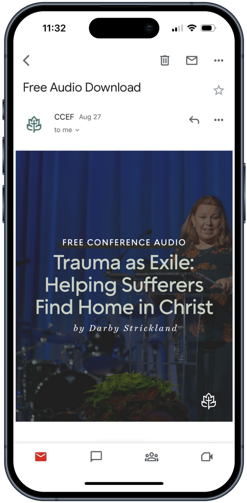
Sign up for our weekly email and receive access to a conference talk by Darby Strickland on helping trauma sufferers find home in Christ.
Loading form...