Christian Counseling & Educational Foundation
1803 East Willow Grove Avenue
Glenside, PA 19038

Our origins and statement of faith
We seek to apply these core commitments of historic orthodoxy in ways that are humble and winsome.
We affirm the unique authority of Scripture, and subscribe to the historic creeds of the early church and Reformation (i.e., Apostles’ Creed, Nicene Creed, Westminster Confession of Faith, London Baptist Confession, Heidelberg Catechism). And though we are Protestants grounded in the Reformed tradition, we also seek to minister to and with Christians from a range of theological perspectives.
The Christian Counseling & Educational Foundation (CCEF) was founded in 1968 and stands in a long tradition of pastoral care that dates back to the 1st century church and the New Testament. Through the centuries there have been high points and low points in the church’s understanding and practice of good pastoral care. High points include the early church fathers, the Reformation, the Puritans and Jonathan Edwards. In principle, for the first 1900 years of the church’s existence, the Scriptures formed the basis for diagnosing both psychological-spiritual maladies and interpersonal problems. And Scripture offered a consistent basis for addressing people’s problems by rooting our lives in the life, death and resurrection of Jesus. So, in many ways, CCEF’s ministry is not new, because its theology expresses this heritage of a God-centered understanding of people and a Christ-centered understanding of how God redeems people. But CCEF is doing something new in terms of its application of these time-tested truths to modern problems.
Whether or not the church was doing a good job of pastoral care, for the first 1900 years all Christians agreed that Scripture was the basis for restoring human lives. But a fundamental shift came with the advent of the modern secular psychologies, pioneered by Sigmund Freud in the late 1800’s. In a short amount of time, historic biblical categories of creation, fall and redemption were replaced by secular categories of mental health and mental illness.
The main effect of that shift meant that secular psychological thinking excised the personal God from the world he made. In the new theories and psychotherapeutic practices, there was no mention of sin, of God, of the necessity of a Savior, or the promise of eternal life. The solution to our “personal and interpersonal problems” lay within us and counseling involved drawing it out.
Though these were secular theories, they greatly impacted the church. From the turn of the 20th century, a shift took place in pastoral care instruction in seminaries. While many seminaries continued to make the Scriptures primary in the preaching of God’s word, they no longer made the Scriptures primary in pastoral care and counseling. This vacuum was filled by a host of alternatives that tended to minimize, change or overshadow the redemptive message of the Scriptures.
Responding to this trend, David Powlison writes in his book Speaking Truth in Love: Counsel in Community:
But as we look more closely at life, it becomes clearer and clearer that Scripture is about counseling: diagnostic categories, causal explanations of behavior and emotion, interpretation of external sufferings and influences, definitions of workable solutions, character of the counselor, goals for the counseling process…These are all matters to which God speaks directly, specifically, and frequently. He calls us to listen attentively, to think hard and well, and to develop our practical theology of conversational ministry.
In response to these trends in the church and pastoral training, a “biblical counseling” movement emerged in the late 1960’s. The initial spokesman for this approach to pastoral care and counseling was Jay Adams. In 1968, Jay Adams and John Bettler started the Christian Counseling & Educational Foundation just outside of Philadelphia. For the past four decades, CCEF has been growing and contributing to the biblical counseling movement as that movement has grown in both influence and maturity. For a more detailed history of the biblical counseling movement, see The Biblical Counseling Movement: History and Context by David Powlison.
CCEF’s early history was largely prophetic and therefore polemic. The church was challenged to rethink its beliefs about why people struggle and how to help them when they do. CCEF called pastors and seminaries back to the primacy of Scripture as the basis for thoughtful and effective pastoral care and counseling. From the beginning, there was always a concern to define what could legitimately be learned from modern psychology, but Scripture provided the orienting “generalizations”: a God-centered view of people and problems and solutions. What was at stake was which source would be primary.
As CCEF entered the 1980’s and 90’s, it was apparent that the second and third generation of leaders benefited from the strengths of their predecessors as well as learned from their weaknesses. They moved CCEF in a direction of increased sensitivity to human suffering, to the dynamics of motivation, to the centrality of the gospel in the daily life of the believer, the importance of the body of Christ and to a more articulate engagement with secular culture.
As CCEF enters the 21st century, it continues this positive trajectory with a commitment to work out the implications of biblical counseling in many areas of counseling methodology. CCEF continues to emphasize the centrality of the body of Christ as the primary context for care and counseling while recognizing the legitimate place of broader resources within the body of Christ. The relationship between biblical counselors and fellow evangelicals involved in professional, clinical counseling continues to be worked out in the pursuit of cordial relationships in which differences can be constructively discussed. Biblical counseling offers a distinctively Christian understanding of people, problems, influences, suffering, motives, and change processes. These beliefs are continuing to be developed and applied at CCEF.
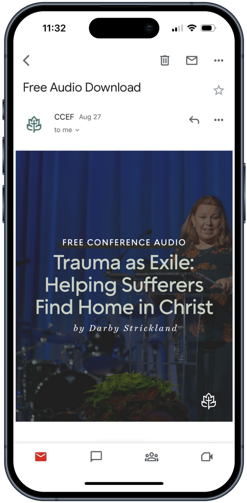
Sign up for our weekly email and receive access to a conference talk by Darby Strickland on helping trauma sufferers find home in Christ.
Loading form...